
 EN
EN
1. Introduction: A Shift in the Making
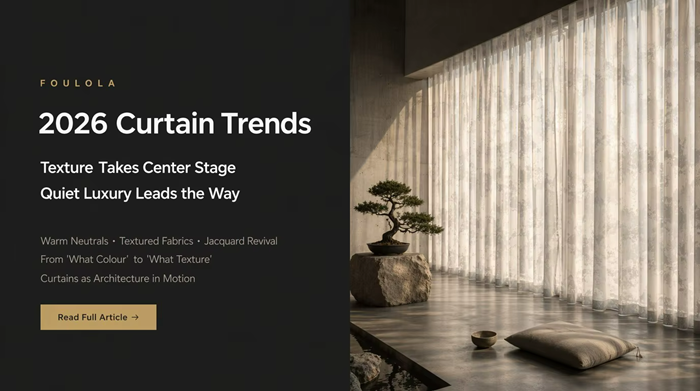
Step into any thoughtfully designed living room today, and you will notice a subtle but unmistakable shift — curtains are moving from "window dressing" to "protagonist of the space."
In 2026, curtains are no longer mere light-blocking tools or afterthought decorative additions. Design media and industry observers are converging on a single direction: curtains are becoming "architecture in motion" — design elements that redefine space, create new functions, and adapt fluidly to occupant needs. They are no longer flat pieces of fabric, but volumetric, layered, emotionally resonant spatial shapers.
What is driving this shift? The answer lies in three interwoven trends: a return to materiality, a therapeutic turn in colour, and an evolution in function.
The global curtain market tells a clear story. Valued at approximately $23.99 billion in 2025, it is projected to reach $25.3 billion in 2026, representing a compound annual growth rate (CAGR) of 5.5%. The curtain fabric market is expanding even faster, at 8.3% CAGR, moving from $16.03 billion in 2026 toward $23.88 billion by 2031. Behind this growth lies a fundamental redefinition of what curtains mean to consumers — moving from "necessity" to "design statement."
2. Colour: From Cool Grey-White to Warm Therapeutic Tones
If there is one definitive trend in 2026 curtain design, it is the wholesale warming of the palette.
2.1 The Return of Warm Neutrals
The 2026 home colour palette is moving away from high-contrast statements toward natural, therapeutic tones. Cool grey-whites are receding, replaced by warm shades carrying the warmth of sunlight — light creams, oatmeals, and soft sands. These colours act "like a delicate filter, making spaces feel soothing and inclusive."
This shift is not accidental. Pantone, Dulux, and Sherwin-Williams — three major colour authorities — have arrived at a rare consensus: serenity, natural resonance, and understated elegance define the annual palette. Low-saturation therapeutic bases, natural textures, and considered blue tones are the hallmarks of this collective turn.
First-hand observations from industry trade fairs confirm this trend: low-saturation warm tones have become the dominant direction, with oatmeals, milk coffees, soft sands, and misty grey-greens gaining particular favour. Styles like Cream Aesthetic, Wabi-sabi, Light French, and Natural Wood — what do they all share? They are all grounded in warm neutral palettes.
2.2 The Three Colour Families
| Colour Family | Representative Hues | Spatial Emotion | Best Suited Styles |
|---|---|---|---|
| Warm Neutrals | Light cream, oatmeal, soft sand, almond beige | Soothing, inclusive, warm | Cream Aesthetic, Wabi-sabi, Natural Wood |
| Evolved Earth Tones | Terracotta, olive green, clay | Grounded, narrative-rich | Modern Minimalist, Light Luxury |
| Serene Blue-Greens | Grey-blue, grey-green, misty mint | Calming, breathable | Studies, bedrooms, modern minimalism |
The rise of "two-tone juxtaposition" is also notable — using subtle colour dialogues to elevate visual layering. Curtains are no longer monochromatic blocks; they can carry more nuanced colour narratives.
3. Fabric: The Era of Texture
If colour is the "expression" of 2026 curtains, fabric is their "soul."
3.1 From "Looks Good from Afar" to "Feels Good Up Close"
The most fundamental shift in 2026 is that curtains have evolved from "looking good at a distance" to "rewarding close inspection." Industry trade fairs are sending a clear signal: move beyond the homogenized competition of cool greys and solid colours, and return to texture and a sense of ease. Natural materials are making a strong comeback — cotton-linen blends, wool, and silk blends are becoming mainstream.
Designers are increasingly specifying velvet, mohair, wool, sheer wool, silk, and raw silk for curtain projects — materials that bring depth and quiet luxury to interiors.
3.2 The Rise of Textured Fabrics
| Fabric Type | Characteristics | 2026 Trend Positioning |
|---|---|---|
| Linen & Linen-Style | Natural texture, breathable, relaxed | Continuing to lead, evolving toward richer expressions |
| Jacquard | Woven texture, tone-on-tone luster, micro-relief | Strong comeback — moving beyond the solid-colour saturation |
| Chenille | Soft pile, excellent drape, warm handfeel | Premium mainstream, versatile in style |
| Velvet / Velour | Luster, weight, quiet luxury | Core position in Quiet Luxury and Old Money aesthetics |
The industry is moving toward differentiation — meeting more individual needs — with jacquard, printed, and embroidered fabrics making a powerful return.
3.3 Why Texture Matters
The value of texture lies in its creation of "perceptible depth." While solid-colour fabrics rely solely on colour for expression, textured fabrics communicate on two dimensions simultaneously — through the play of light and shadow, and through tactile variation. As 2026 curtain trend analysis notes: "Texture is where the real action is in 2026, with fabrics that have depth and tactile interest becoming increasingly popular."
For B2B buyers, this means: clients are no longer satisfied with "what colour is this?" — they are now asking "what texture is this?"
4. Craftsmanship: The Renaissance of Jacquard
4.1 Jacquard: From Technique to Design Language
Among all texturing techniques, jacquard is undergoing a true renaissance.
Jacquard is not printed on or embroidered onto the fabric — it is woven in. Through the interplay of warp and weft threads, the pattern is constructed directly at the structural level of the fabric. This means the pattern is part of the fabric itself, not an applied layer. It will not fade, peel, or wear away.
In 2026, jacquard techniques are evolving in several clear directions:
-
Tone-on-Tone Jacquard: Same-colour shadow patterns, subtle from a distance, refined up close — the craft essence of "Quiet Luxury"
-
Three-Dimensional Jacquard: Varying float lengths create a micro-relief effect on the fabric surface
-
Metallic Jacquard: Incorporating metallic-lustre yarns into the weave, allowing patterns to shift and shimmer as light moves across the surface
4.2 Sheers: From Supporting Role to Leading Act
Another significant craft trend is the comprehensive upgrade of the sheer curtain category.
Traditionally, sheers were viewed as the "supporting act" — a layer of translucent fabric with limited function and perceived value. But in 2026, sheers are emerging as an independent "design category" in their own right.
Industry observers note that sheer curtain sales as a proportion of curtain businesses are rising rapidly, becoming a new growth driver. Younger consumer segments are increasingly receptive to sheers, with more and more clients choosing sheers directly for living rooms and balconies.
Factors driving this shift include:
-
The "light renovation, heavy decoration" consumption philosophy: sheers are lighter, more translucent, and more ethereal than traditional drapes
-
The proliferation of large balconies and floor-to-ceiling windows: sheers maximise daylight retention while providing privacy
-
The popularity of new styling approaches like "single-layer sheers" and "double-layer sheers"
Jacquard sheers, in particular, are gaining favour — balancing base fabric density with jacquard openness to create a silhouette that is softly blurred by day and warmly luminous by night. Jacquard craftsmanship is transforming sheers from "translucent cloth" into "fabric with content."
5. Function: Redefining the Curtain's Spatial Role
5.1 From Window Dressing to Space Divider
One of the most interesting design trends in 2026 is the migration of curtains from windows to the wider space. Design trend observers note that curtains as interior partitions are becoming a core annual trend — curtains are no longer just covering windows; they are replacing walls and redefining space.
In open-plan spaces, curtains become flexible zoning tools — creating intimate corners when needed, and opening fully to restore spatial flow when not. Unlike traditional walls or doors, curtain partitions are reversible, adjustable, and breathable.
5.2 "Light In, Eyes Out": The Functional Upgrade of Sheers
The functional positioning of sheers is also evolving. The traditional value proposition of sheers was simply "light transmission." But in 2026, sheers are being asked to do more: "light in, eyes out" — preserving natural light while providing effective daytime privacy.
This demand has given rise to higher-weight, denser "functional sheers" — combining the lightness of sheers with the opacity of drapes. High-twist, snag-resistant, fabric-as-structure sheer products are becoming the new choice for living rooms and public areas.
6. Quiet Luxury: The Underlying Aesthetic of 2026 Curtain Design
All of the above trends — warm colour palettes, textured fabrics, jacquard craftsmanship, sheer upgrades — converge on a single aesthetic direction: Quiet Luxury.
What is Quiet Luxury? Not ostentatious extravagance, not visible logos, but a "quiet sense of quality" — an assurance that does not need to announce itself.
In curtain design, Quiet Luxury manifests as:
-
In colour: Low-saturation warm tones that are neither competitive nor loud, yet age beautifully
-
In fabric: Materials with tactile depth and substance, rather than flat synthetics
-
In craftsmanship: Jacquard, weaving, and other "invisible" techniques, rather than printed "visible" patterns
-
In presentation: Subtle from a distance, refined up close — beauty that reveals itself over time
Designers are using velvet, mohair, wool, silk, and other materials to create this "quiet depth." The jacquard shadow patterns on sheers, the micro-relief on fabric surfaces, the patterns that emerge and recede with shifting light — these are the craft expressions of Quiet Luxury.
For B2B buyers, understanding Quiet Luxury means understanding the logic behind client choices: they are not simply buying a piece of fabric, but a "quality that does not shout."
7. From Trend to Product: One Manufacturer's Design Response
In curtain manufacturing, one factory has witnessed every turn in fabric trends over the past 25 years — from solid-colour plains to printed patterns, from minimalist solids to the current return to texture.
Within Foulola's product lines, several collections are responding to 2026 design directions. Take the 2628-7# Jacquard Line-Drawn Floral Sheer — a large-scale jacquard sheer where the pattern is not printed, but woven through the interplay of warp and weft floats. On a pure white base, the floral motif emerges entirely through the fabric's structural light-and-shadow contrasts — solid from a distance, floral shadows shifting up close. This "tone-on-tone" jacquard effect is a quintessential expression of Quiet Luxury in the sheer category.
The 2668-7# Metallic Peony Jacquard Sheer takes this further — peony motifs woven into the fabric, with metallic threads catching the light. As daylight shifts, the pattern emerges and recedes, its lustre flowing with the sun's movement. This is not only jacquard craftsmanship at work, but a direct response to the "texture is king" trend.
The MNHY series (Thousand Li of Rivers and Mountains, Forest Botanical, Harvest Wheat, and other metallic jacquard sheers) pushes jacquard toward richer narrative expressions — weaving cultural symbols and natural imagery into the fabric. The 3.0m width allows landscape scrolls to unfold seamlessly across expansive windows — a response to the 2026 "wall-to-wall drape" trend.
8. Conclusion: The "Age of Texture" in Curtain Design
In 2026, curtain design is undergoing an evolution from "flat" to "dimensional."
It is no longer a piece of fabric in a window frame. It is a colour therapist, a texture carrier, a craft canvas, a space divider. Curtains are moving from "what colour do I have" to "what texture do I have" — a fundamental value shift.
For designers, buyers, and project specifiers, the selection criteria are changing: no longer "does this fabric look good," but "what texture, warmth, and attitude does this fabric convey."
In the era where texture is king, the value of a curtain lies not in what it blocks, but in what it presents.
And when a curtain allows light to flow across the peaks and valleys of its weave, allows patterns to emerge and recede in the depths of its structure, allows a space to breathe through the folds of its drape — it is no longer just a piece of fabric. It is the quietest presence in the room, and the most powerful expression.
References
-
The Business Research Company. (2026). Curtains Global Market Report 2026.
-
Deep Market Insights. (2026). Curtain Fabric Market Size, Share & Growth Report | 2031.
-
Hammonds. (2026). Top curtain trends for 2026.
-
Just Fabrics. (2026). New Curtain Ideas & Curtain Trends for 2026.
-
Fashion Week Online. (2026). 2026 Curtain Trends: How Tailored Linen Designs Are Shaping Modern Home Décor.
Table of Contents
- 1. Introduction: A Shift in the Making
- 2. Colour: From Cool Grey-White to Warm Therapeutic Tones
- 3. Fabric: The Era of Texture
- 4. Craftsmanship: The Renaissance of Jacquard
- 5. Function: Redefining the Curtain's Spatial Role
- 6. Quiet Luxury: The Underlying Aesthetic of 2026 Curtain Design
- 7. From Trend to Product: One Manufacturer's Design Response
- 8. Conclusion: The "Age of Texture" in Curtain Design
- References

