
 EN
EN

Jacquard vs. Printed vs. Embroidered: Which Curtain Fabric Lasts and Why Buyers Should Care
A Practical Guide for Fabric Wholesalers, Curtain Shops, Interior Designers, and Hotel Buyers
By Foulola Product Team | 25 Years of Curtain Fabric Manufacturing
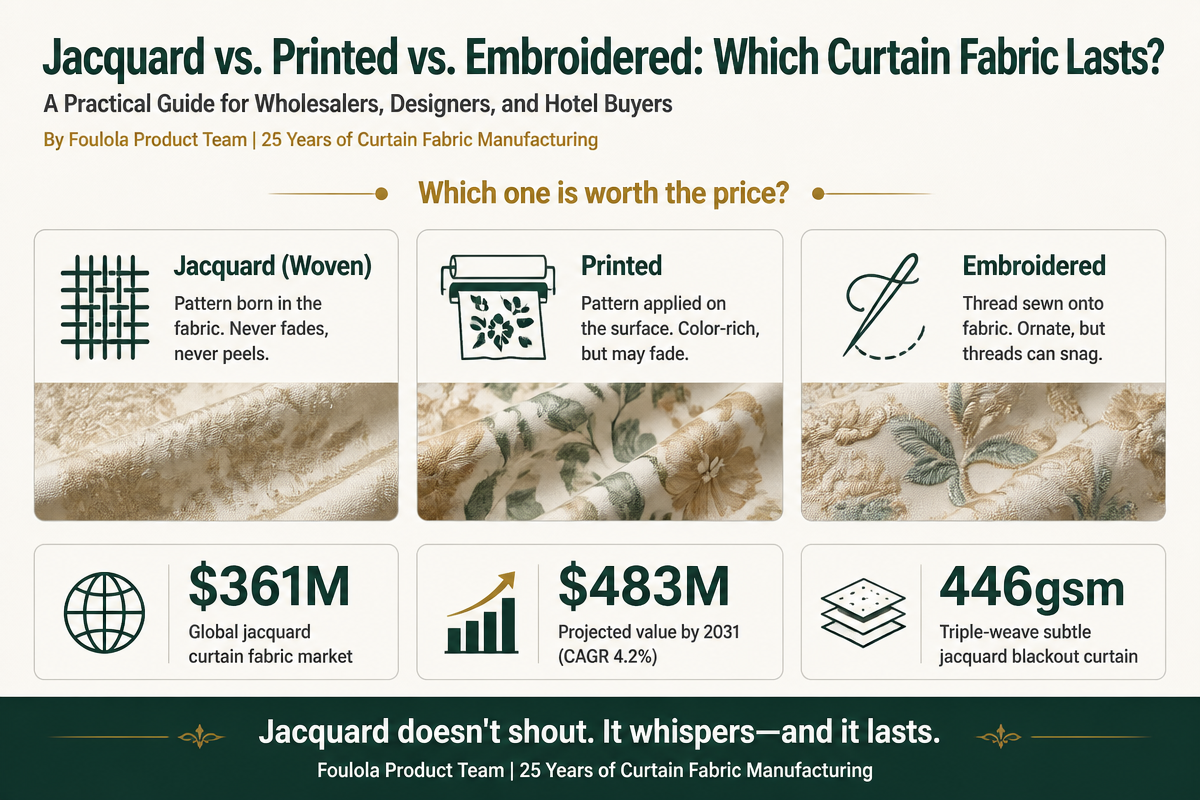
If you only remember one thing: printed patterns sit on the surface, embroidered patterns are sewn on, but jacquard patterns are born into the fabric. The article below breaks down the three techniques and helps you choose the right one for your project.
1. Why Do Two Curtains with Similar Patterns Cost So Differently?
Walk into any curtain showroom, and you will face a confusing choice: printed, embroidered, or jacquard — terms that appear frequently in sales pitches and product labels, yet their distinctions often remain unclear. Why do fabrics with seemingly similar patterns vary so widely in price?
More importantly, when you stand before a floor-to-ceiling window and watch light move across the curtain surface, have you ever considered that some patterns are "applied" to the fabric, some are "sewn" onto it, and some are actually "born" within it?
The essential differences between these three processes determine durability, handfeel, perceived quality, and — perhaps most importantly — how long the curtain will maintain its presence in your space.
2. What Exactly Is Subtle Jacquard?
To understand subtle jacquard, we must first understand jacquard itself.
Jacquard is a weaving process that creates patterns directly during fabric construction. The principle is straightforward: a jacquard loom controls the rise and fall of each warp thread, interlacing them with weft threads to "weave" patterns into the fabric. The pattern is not printed on, nor embroidered on — it is an integral part of the fabric itself.
In 1801, Joseph-Marie Jacquard demonstrated his invention at the Paris Industrial Exhibition. His jacquard device used punched cards to control the lift of warp threads — holes allowed needles to pass through, lifting the threads; no holes meant needles were pushed aside, leaving threads stationary. Each card corresponded to one pass of the shuttle, and an entire pattern was decomposed into thousands of cards. This mechanism later inspired the punched card systems of early computers, earning the jacquard loom its reputation as one of the "ancestors of computing."
"Subtle jacquard" is a specialized branch within the jacquard family. Its "subtlety" manifests in two dimensions:
-
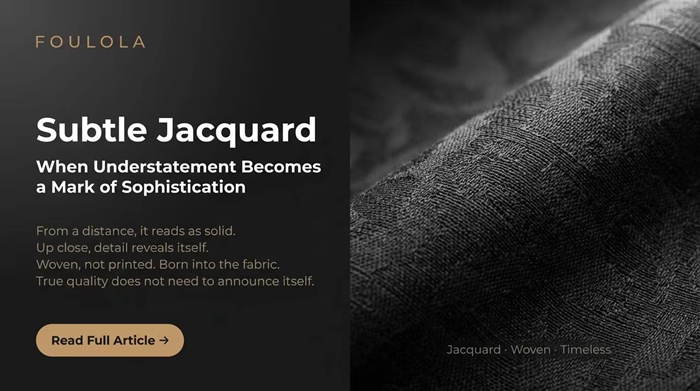
Restrained patterns: Subtle jacquard patterns are typically tonal or very low-contrast textures — shadow stripes, fine geometrics, tone-on-tone motifs. From a distance, the fabric reads as solid; up close, the detail reveals itself.
-
Precision weaving: Subtle jacquard demands higher thread density and finer yarn control to achieve textured effects that are refined rather than overwhelming.
This "quiet sophistication" is precisely what makes subtle jacquard one of the most coveted techniques in premium curtain manufacturing. Foulola's 518# High-Density Subtle Jacquard Blackout Curtain exemplifies this approach: a 446gsm triple-weave construction where the outer layer carries a finely woven jacquard pattern — achieved through weaving, not printing or embroidery. The texture is pure, and the quality is enduring.
3. Jacquard, Printed, Embroidered: What's the Real Difference?
Jacquard, printed, and embroidered — the core distinctions between these three techniques determine significant differences in quality, durability, and aesthetic suitability.
3.1 Jacquard (Woven Pattern)
Jacquard patterns are formed during weaving through the interlacing of warp and weft threads. The pattern is part of the fabric's structure, not an added layer.
-
Handfeel: Smooth and refined, or with a subtle texture, without affecting the fabric's natural drape.
-
Durability: Exceptionally high. Woven patterns do not fade, peel, or wear off.
-
Perceived quality: Understated sophistication. Under light, jacquard textures reveal subtle dimensional depth and gentle luster.
-
Best suited for: Modern minimalism, light luxury, hotel projects, high-end residential.
3.2 Printed
Printed patterns are applied to the fabric surface using dyes or pigments. The pattern sits on top of the fabric rather than becoming part of the fibre structure.
The curtain industry has largely transitioned from traditional screen printing to heat transfer printing (dye sublimation). Heat transfer printing uses high temperatures to "sublimate" dyes from transfer paper into the fabric fibres, integrating the pattern with the material. Unlike screen printing, heat transfer printing does not create a coating on the fabric surface — it remains soft, breathable, and retains the fabric's original handfeel.
-
Handfeel: Consistent with the base fabric — soft, breathable, with no stiffening effect.
-
Durability: Depends on dye quality and process control. Premium heat transfer prints offer good colourfastness, though prolonged sunlight exposure or frequent washing may cause fading.
-
Perceived quality: Entirely design-dependent. A well-executed print can be genuinely refined; a poor one can appear cheap.
-
Best suited for: Versatile and adaptable — ideal for spaces that seek to express personality.
A note on "stiffness": Traditional screen printing used pigment pastes that formed a film on the fabric surface, often resulting in stiff handfeel and reduced breathability. However, this technique has been almost entirely phased out in the curtain industry. Contemporary heat transfer printing does not suffer from this issue. Therefore, "stiff handfeel" should no longer be used as a generalized criticism of printed curtains.
3.3 Embroidered
Embroidery involves stitching patterns onto existing fabric using thread. The pattern is a superimposed structure on the fabric surface.
-
Handfeel: Highly dimensional, with distinct thread texture. The reverse side has embroidery backing, making localized areas thicker.
-
Durability: Good, though threads may pill or snag with extended use.
-
Perceived quality: Traditional and ornate — high craftsmanship value, though harder to integrate into modern minimalist interiors.
-
Best suited for: Chinese classical, European classical, boutique hotels, Neo-Chinese style.
4. Core Comparison: Three Techniques at a Glance
| Comparative Dimension | Subtle Jacquard (Woven) | Printed | Embroidered |
|---|---|---|---|
| Process Principle | Warp and weft interlacing creates pattern during weaving | Dye transferred to fabric surface | Thread sewn onto existing fabric |
| Pattern Appearance | Tonal textures, fine details, subtle dimension | Colour-rich, can be vibrant or complex, flat surface | Highly dimensional, visible stitch texture |
| Durability | Exceptional — pattern never fades or peels | Good — depends on dye quality | Good — threads may pill or snag over time |
| Handfeel | Smooth or micro-textured, drape unaffected | Soft and breathable, no stiffness | Localized thickening, backing on reverse |
| Perceived Quality | Understated sophistication — subtle from afar, refined up close | Design-dependent | Traditional craftsmanship, ornate appeal |
| Best Suited For | Modern minimalism, light luxury, hotels, high-end residential | Versatile, personality-driven spaces | Chinese classical, European classical, boutique hospitality |
5. Why Does Subtle Jacquard Feel More "Premium"?
5.1 High Technical Barriers
Jacquard weaving requires specialized looms and complex programming — capabilities beyond standard weaving equipment. The precision required to control thousands of threads independently is a mark of industrial sophistication.
5.2 The Philosophy of "Quiet Sophistication"
True luxury rarely announces itself. Subtle jacquard patterns emerge and recede with changing light — morning sidelight, afternoon sun, evening warmth — each creating a different depth of texture. This "beauty that takes time to discover" is far more enduring than bold prints and places greater demands on the quality of the base fabric.
5.3 Uncompromised Handfeel and Drape
Printing adds colour to the surface; embroidery adds thread to the surface — both "add" something. Jacquard, by contrast, creates the pattern during weaving itself, without adding any extra layer. This means that the drape and handfeel of a jacquard curtain are determined entirely by the base fabric — unaffected by stiffening, thickening, or loss of drape.
5.4 Durability Is the Highest Form of Quality
No fading. No peeling. No deformation. A jacquard pattern is "born" into the fabric. Over time, prints may fade and embroidery threads may fray, but a jacquard texture remains as defined as the day it was woven. This "quality that ages well" is the fundamental reason why premium hotels and luxury residential projects consistently favour jacquard curtains.
6. Market Evidence: The Numbers Behind the Trend
The global jacquard curtain fabric market was valued at $361 million in 2024 and is projected to reach $483 million by 2031, representing a CAGR of 4.2%. A parallel market analysis offers a similar estimate: $369 million in 2025, reaching $476 million by 2031 at a CAGR of 4.4%.
What is driving this growth?
On one side, it is the consistent demand from high-end hospitality and commercial projects. The durability and textural presence of jacquard fabrics make them the default choice for hotel guest rooms, executive lounges, and conference spaces. On the other, it is residential market upgrading — an increasing number of homeowners are recognising that the value of a curtain lies not only in light control, but in texture and material quality.
| Market Metric | Value |
|---|---|
| Global jacquard curtain fabric market (2024) | $361 million |
| Projected market (2031) | $483 million |
| CAGR (2024–2031) | 4.2% |
| Alternative estimate (2025) | $369 million |
| Alternative projection (2031) | $476 million |
| Alternative CAGR | 4.4% |
7. Where Does Subtle Jacquard Work Best?
Modern Minimalist Interiors
Choose tonal jacquards (deep grey shadow textures, creamy white subtle weaves) to add fabric depth while maintaining spatial simplicity. As light moves, textures appear and recede — the space comes alive.
Light Luxury / Italian Contemporary
Pair with metal curtain rods or brass hardware. Light across the jacquard surface creates subtle luster shifts — "quiet refinement" is the essence of this aesthetic.
Hospitality / Commercial Spaces
Subtle jacquard is the ideal partner for blackout curtains — triple-weave construction delivers 90–95% physical blackout, while the jacquard texture adds aesthetic value beyond pure function. For hotel procurement, this combination delivers "full performance, uncompromised quality."
8. From Craft to Product: One Factory's Practice
In the field of jacquard weaving, one manufacturer has been dedicated to the craft for over 25 years. Among its product offerings, the 518# High-Density Subtle Jacquard Blackout Curtain stands as a representative example of subtle jacquard at its best.
This fabric features a triple-weave construction, with the outer layer carrying a finely woven jacquard pattern created directly during the weaving process — not printed, not embroidered, but woven into the fabric itself. The 446gsm density not only delivers 90–95% physical blackout but also provides the substantial "canvas" required for subtle jacquard, allowing the shadow patterns and light-play to reach their full expression.
Behind this product is Foulola — a manufacturer that views subtle jacquard not merely as a process option, but as a design philosophy: quality that does not need to announce itself.
(Note: This is an actual Foulola product, shared as an example of how jacquard craftsmanship translates into production. The principles apply across the industry. Always request physical samples for your specific project.)
9. Conclusion: Understatement Is a Choice
Printed, embroidered, jacquard — these three techniques have no absolute hierarchy. They serve different design objectives and budget considerations. Printing is versatile, expressive of personality. Embroidery is crafted, suited to classical traditions. And subtle jacquard? It represents a design choice that prioritises "quiet sophistication."
When a fabric's pattern is not applied, but born into it — when light reveals texture as it moves, and time only deepens its presence — that is the value of subtle jacquard.
It is not about impact at first glance. It is about keeping your attention at the hundredth.
This article is part of Foulola's Fabric Knowledge Series. For more technical details on subtle jacquard or product enquiries, please visit www.foulola.com.
References
-
Foulola 518# High-Density Subtle Jacquard Blackout Curtain — product documentation.
-
Market data: Global jacquard curtain fabric market reports (2024–2031).
Table of Contents
- Jacquard vs. Printed vs. Embroidered: Which Curtain Fabric Lasts and Why Buyers Should Care
- 1. Why Do Two Curtains with Similar Patterns Cost So Differently?
- 2. What Exactly Is Subtle Jacquard?
- 3. Jacquard, Printed, Embroidered: What's the Real Difference?
- 4. Core Comparison: Three Techniques at a Glance
- 5. Why Does Subtle Jacquard Feel More "Premium"?
- 6. Market Evidence: The Numbers Behind the Trend
- 7. Where Does Subtle Jacquard Work Best?
- 8. From Craft to Product: One Factory's Practice
- 9. Conclusion: Understatement Is a Choice
- References

