
 EN
EN

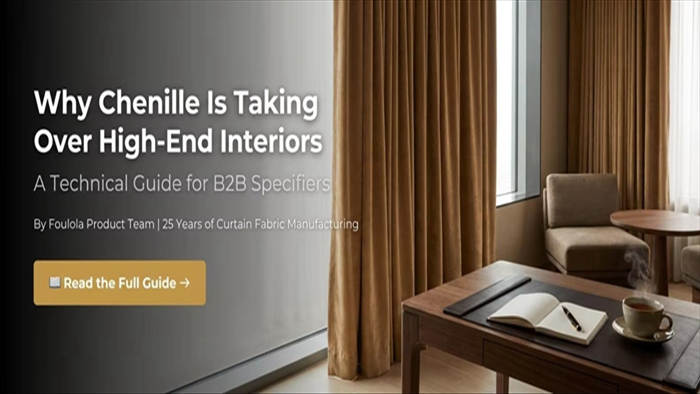
By Foulola Product Team | 25 Years of Curtain Fabric Manufacturing
When a hotel procurement manager shortlists curtain fabrics for a 200-room project, the first filters are predictable: blackout level, FR compliance, acoustic performance. These are the hard metrics. They are objective. They are easy to compare.
But once a dozen fabrics pass the technical threshold, what separates the final selection from the rest?
Increasingly, the answer is touch.
Chenille — a fabric category once confined to upholstery — has quietly crossed over into high-end curtain specification.
Walk through a recently renovated luxury hotel in Dubai, a boutique apartment in Melbourne, or a design-forward co-working space in Berlin, and you are likely to see chenille curtains framing the windows. Not velvet. Not plain linen. Chenille.
Why? Because chenille solves a problem that most specifiers don't realise they have until they compare samples side by side: it bridges the gap between technical performance and sensory experience.
This article is a technical guide for fabric wholesalers, hotel procurement managers, and interior designers who want to understand what makes chenille different — not in marketing language, but in data, structure, and application logic.
I. What Chenille Actually Is — A Structural Explanation
Before discussing why chenille matters, it is necessary to clarify what it is.
1.1 Yarn Structure
Chenille is not a fibre type. It is a yarn construction method.
|
Yarn Type |
Structure |
Surface Characteristic |
Typical Applications |
|
Standard Spun Yarn |
Parallel fibres twisted together |
Smooth, flat surface |
General-purpose fabrics |
|
Chenille Yarn |
Short fibre tufts trapped between two core yarns, projecting outward |
Velvety, plush pile surface |
Upholstery, high-end curtains |
|
Slub Yarn |
Intentional thick-and-thin variations |
Irregular, textured surface |
Decorative fabrics |
The defining feature of chenille yarn is its pile — short fibres that stand perpendicular to the core. These fibres create a surface that is soft to the touch and visually dense.
When woven into a fabric, the pile catches light at multiple angles, creating a depth of colour that flat-weave fabrics cannot replicate.
1.2 Why Chenille Feels Different — And Why That Matters in B2B
Touch is subjective, but it has measurable commercial consequences. In the hospitality industry, guest satisfaction scores are influenced by tactile experiences. A curtain that feels substantial, soft, and warm contributes to the perception of a well-appointed room.
Tactile Comparison Table (Industry Reference Values)
|
Fabric Type |
Hand Feel (1-10 Scale)* |
Perceived Quality |
Guest Comfort Correlation |
|
Standard Polyester Plain Weave |
3–4 |
Basic |
Low |
|
Linen-Style Fabric |
5-6 |
Natural, relaxed |
Medium |
|
Brushed Linen-Blend |
6-7 |
Soft, approachable |
Medium-High |
|
Chenille (314–446gsm) |
8-9 |
Plush, luxurious |
High |
|
Velvet |
8-9 |
Opulent, formal |
High |
Scale based on industry reference values for softness, pile density, and drape quality. Not derived from internal lab testing.
The data indicates a clear pattern: chenille and velvet occupy the top tier of tactile perception. However, velvet carries certain liabilities — it is heavier, more expensive, and prone to crushing in high-traffic environments.
Chenille, by contrast, offers comparable softness with better durability and a wider weight range.
II. The Four B2B Value Propositions of Chenille Curtain Fabrics
2.1 Tactile Premium — The Invisible Currency of High-End Spaces
In B2B procurement, "softness" is rarely listed as a specification requirement. Yet it consistently influences final selection. Why?
Because specifiers are not buying fabric for themselves. They are buying fabric for end users — hotel guests, residents, patients, customers.
And end users judge spaces not by data sheets, but by sensory experience. Touch is the first sense engaged when a guest draws a curtain. A rough or synthetic hand feel signals cost-cutting. A plush, velvety hand signals care.
This is the tactile premium — the invisible value that chenille brings to a space without being specified.
How to evaluate tactile premium in procurement:
|
Evaluation Criteria |
What to Look For |
Red Flag |
|
Pile Density |
High number of short fibres per square cm |
Sparse, uneven pile |
|
Surface Recovery |
Pile returns to position after being pressed |
Pile stays flattened |
|
Drape Quality |
Deep, rounded folds; substantial feel |
Stiff or limp hang |
2.2 Visual Depth — Why Chenille Colours Appear Richer
The same colour code — say, a muted blue — will look different on a plain weave polyester than on a chenille fabric. This is not a manufacturing defect. It is physics.
How chenille affects colour perception:
|
Mechanism |
Explanation |
Visual Result |
|
Multi-angle light scattering |
Pile fibres reflect light in multiple directions |
Deeper, more saturated appearance |
|
Shadow trapping |
Light is trapped between pile fibres, creating micro-shadows |
Richer tonal variation |
|
Reduced surface sheen |
Unlike flat weaves, chenille scatters reflected light |
Matte, sophisticated finish |
For hotel projects where the curtain colour must complement wall coverings, bedding, and carpet, chenille's ability to render colour with depth and nuance is a practical advantage — not just an aesthetic one.
Acoustic Performance Estimates by GSM (Industry Reference Values)
|
Fabric Weight |
Estimated Noise Reduction Coefficient (NRC)* |
Best Application |
|
Lightweight (250–314gsm) |
0.15–0.25 |
Residential bedrooms, standard hotel rooms |
|
Mid-weight (375–428gsm) |
0.25–0.40 |
Hotel suites, open-plan offices |
|
Heavyweight (446gsm+) |
0.35–0.50 |
Hotel lobbies, conference rooms, street-facing apartments |
NRC values are industry reference estimates for heavyweight curtain fabrics with pile surfaces. Actual performance varies by installation method, fabric tension, and room acoustics. These are not lab-tested values for specific Foulola products.
For a procurement manager specifying curtains for a hotel near a busy road, a heavyweight chenille offers an acoustic advantage that a standard blackout curtain of the same weight cannot match — simply because of the pile.
2.4 Durability — Why Chenille Lasts Longer Than It Feels
There is a common misconception in B2B procurement: soft fabrics are fragile. This assumption is incorrect for well-constructed chenille.
Why chenille is structurally resilient:
|
Structural Feature |
Durability Benefit |
|
Core yarn anchoring |
Pile fibres are trapped between two core yarns; they resist being pulled out |
|
High twist density |
Tighter twist = stronger core = less fibre shedding |
|
Dense weave construction |
Higher picks per inch lock pile fibres in place |
For hotels, where curtains face daily handling by guests and housekeeping, this structural resilience translates directly into longer replacement cycles and lower total cost of ownership.
III. How to Evaluate Chenille Fabrics — A B2B Procurement Framework
Not all chenille fabrics are equal. Three variables determine performance and application suitability.
3.1 GSM — The Single Most Important Predictor of Performance
In chenille curtain fabrics, weight is not just a number. It is a proxy for drape, blackout, and acoustic performance.
GSM Performance Matrix (Industry Reference Values)
|
GSM Range |
Drape Quality |
Blackout Potential |
Acoustic Performance |
Best Application |
|
250–314gsm |
Soft, relaxed |
85–90% |
Light |
Residential, standard hotel rooms |
|
375–428gsm |
Fluid, substantial |
90–95% |
Moderate |
Hotel suites, high-end residential |
|
446gsm+ |
Heavy, grounded |
95–99% |
Significant |
Hotel lobbies, street-facing windows, conference rooms |
Procurement rule of thumb: if the project requires acoustic performance and a premium drape, start with the heavyweight category. If the priority is a soft hand feel with moderate blackout, the mid-weight category is the pragmatic choice.
3.2 Construction — Double-Sided vs Single-Sided Jacquard
Chenille fabrics can be constructed with different face and reverse treatments. Understanding these differences prevents costly specification errors.
Construction Comparison
|
Construction Type |
Face |
Reverse |
Best Application |
|
Single-Sided Jacquard |
Woven jacquard pattern |
Solid plain weave |
Standard installations, single-side visible spaces |
|
Double-Sided Jacquard |
Woven jacquard pattern |
Identical jacquard pattern |
Open-plan spaces, both sides visible |
For hotel lobbies with freestanding curtain panels visible from both sides, double-sided chenille eliminates the "wrong side" problem. For guest rooms where only the face is visible, single-sided construction is the cost-effective specification.
3.3 Functional Finishing Compatibility
Chenille fabrics can be enhanced with functional finishes — but not all combinations are possible.
Functional Finishing Compatibility Table
|
Treatment |
Compatibility with Chenille |
Notes |
|
Flame Retardant (NFPA 701) |
√ Compatible |
Surface treatment; does not affect pile integrity |
|
Antibacterial |
√ Compatible |
Industrial-grade treatment; fabric-friendly |
|
Water-Proof |
√ Compatible |
Cannot be combined with FR on the same fabric |
|
Stain-Resistant |
√ Compatible |
Extends fabric life in high-use areas |
|
Fragrance Finish |
√ Compatible |
Microencapsulated; gradual release |
Critical note: FR and water-proof treatments are mutually exclusive on the same fabric. Specifiers who require both properties should contact the manufacturer for alternative solutions.
IV. Application Matrix — Matching Chenille Types to Space Types
Space-to-Fabric Matching Table
|
Space Type |
Recommended GSM |
Construction |
Key Requirements |
|
Hotel Guest Room |
314–428gsm |
Single-sided |
Blackout, acoustic, soft hand feel |
|
Hotel Suite |
428–446gsm |
Double-sided preferred |
Premium drape, colour depth, acoustic |
|
Hotel Lobby |
446gsm+ |
Double-sided |
Acoustic, visual impact, durability |
|
High-End Residential |
375–446gsm |
Single or double-sided |
Touch, colour depth, drape |
|
Open-Plan Office |
375–428gsm |
Double-sided |
Acoustic, both sides visible |
|
Healthcare / Senior Living |
314–428gsm |
Single-sided |
Class A eco-certified, antibacterial, FR |
V. The Procurement Decision Framework — A Step-by-Step Guide
For B2B buyers evaluating chenille curtain fabrics, the following decision sequence is recommended:
Step 1: Define the space type.
→ Hotel guest room? Lobby? Residential? This determines the GSM range.
Step 2: Identify functional requirements.
→ Blackout level? FR standard? Acoustic need? Eco certification?
Step 3: Select construction type.
→ Single-sided for standard installations. Double-sided for open-plan spaces.
Step 4: Choose texture and colour.
→ Solid chenille for timeless specification. Subtle jacquard for architectural texture.
Step 5: Request samples.
→ Always test under the actual lighting conditions of the project space.
Step 6: Confirm MOQ and lead time.
→ Stocked fabrics can ship in days. Custom colours and weaves require longer lead times.
VI. Conclusion — Chenille as a Specification Strategy
Chenille is not the right fabric for every project. It is heavier than standard polyester. It is typically more expensive per metre than basic blackout fabrics. And it is over-specified for budget-driven projects where price is the primary filter.
But for projects where the end-user experience matters — where a guest's perception of quality is shaped by what they touch, see, and hear — chenille offers a measurable advantage that goes beyond any single specification sheet.
It is not just a fabric choice. It is a specification strategy.
VII. How to Explore Chenille Options
If you are evaluating chenille curtain fabrics for an upcoming project, the most productive next step is a conversation — not a quote, not a contract.
Share your project requirements, and a manufacturer with a full chenille product matrix can help you identify the right specification.
Foulola, a 25-year curtain fabric manufacturer, offers chenille fabrics across multiple GSM ranges, construction types, and functional finishes — from lightweight brushed blends to heavyweight jacquard weaves. All available in ready-stock widths with flexible MOQ.
→ [Explore Chenille Curtain Fabric Collections →]
→ [Request a Sample or Speak to Our Team →]
Table of Contents
- I. What Chenille Actually Is — A Structural Explanation
- II. The Four B2B Value Propositions of Chenille Curtain Fabrics
- III. How to Evaluate Chenille Fabrics — A B2B Procurement Framework
- IV. Application Matrix — Matching Chenille Types to Space Types
- V. The Procurement Decision Framework — A Step-by-Step Guide
- VI. Conclusion — Chenille as a Specification Strategy
- VII. How to Explore Chenille Options

