
 EN
EN

How to Source Sustainable Curtain Fabric: Certifications, Recycled Materials, and Indoor Air Quality
A Practical Sourcing Guide for Fabric Wholesalers, Curtain Shops, Interior Designers, and Hotel Buyers
By Foulola Product Team | 25 Years of Curtain Fabric Manufacturing
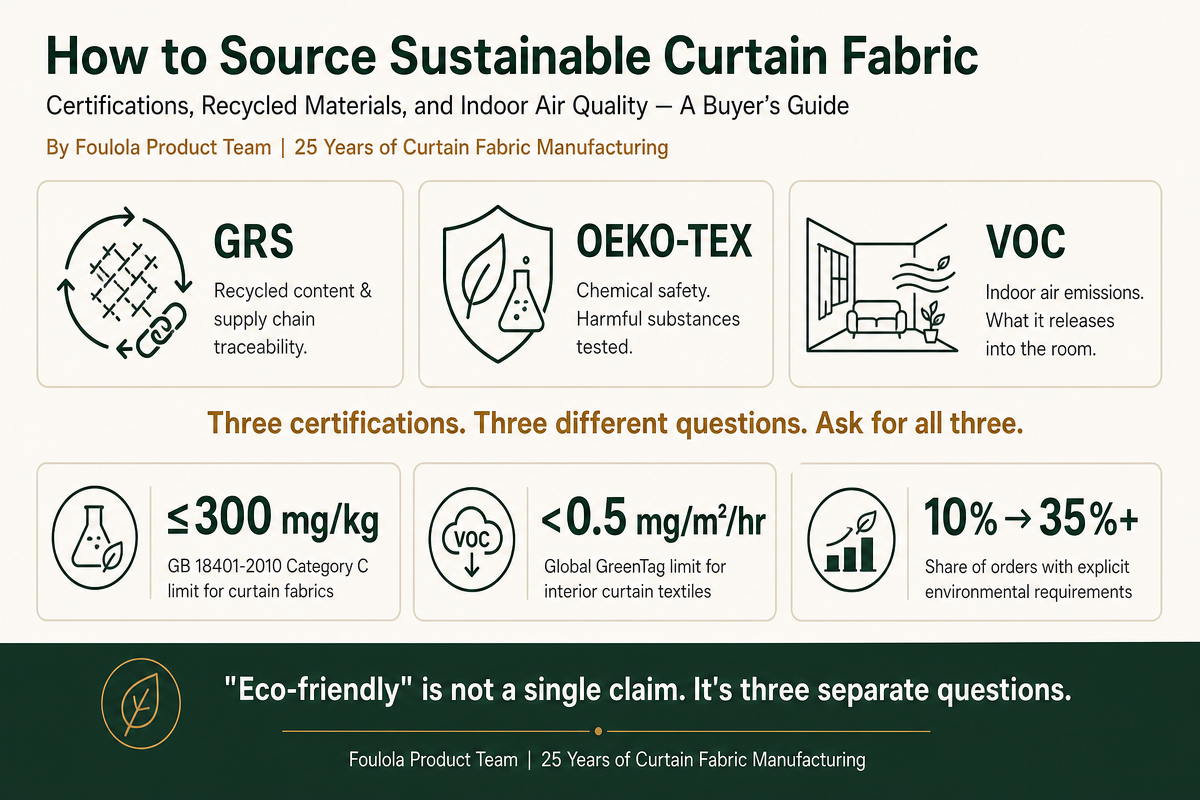
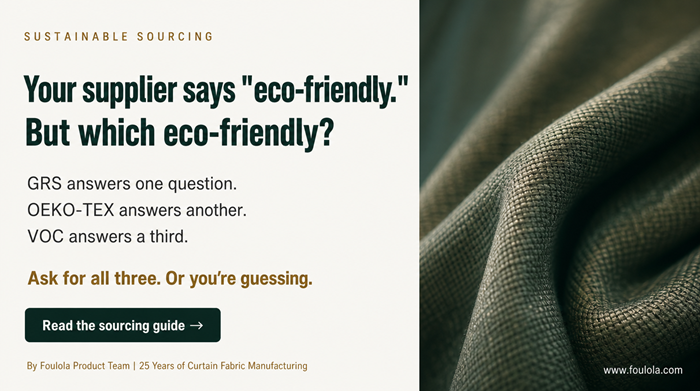
If you only remember one thing: "eco-friendly" is not a single claim—it's three separate questions. GRS covers material source. OEKO-TEX covers chemical safety. VOC covers indoor air quality. The article below explains each one, and gives you a five-question checklist to evaluate any supplier.
1. Why Has "Eco-Friendly Fabric" Become Such a Headache for Buyers?
In 2026, your clients—whether hotel procurement managers, interior designers, or end users—are asking one question more frequently: "Is this fabric sustainable?"
That question is fair. The problem is the answer.
The typical supplier response goes something like this: "We're eco-certified." "It's recycled material." "Absolutely safe." These claims sound fine, but they lack verifiable substance. Buyers are left unable to tell whether a fabric is sustainable in terms of raw material sourcing, chemical safety, or indoor emissions.
Meanwhile, demand for sustainable curtains is genuinely growing. The hospitality industry operates over 5 million hotel rooms in the United States alone, with window treatments typically replaced every 5–8 years. Sustainable blackout curtains are entering this large-scale procurement cycle. For fabric wholesalers and curtain shops, the ability to offer certified sustainable products is shifting from a "nice-to-have" to a market access requirement.
This article addresses one question: how do you turn "eco-friendly" from a vague adjective into a verifiable procurement standard?
2. GRS, OEKO-TEX, Greenguard Gold: What's the Actual Difference?
This is where buyers get confused most often. Environmental certifications on the market cover completely different dimensions. Choose the wrong one, and you may end up with fabric that has high recycled content but fails chemical safety standards.
| Certification | Focus Area | What It Tests | What It Means for Buyers |
|---|---|---|---|
| GRS (Global Recycled Standard) | Recycled content & supply chain traceability | Verifies the percentage of recycled material in the product; traces the full journey from recycling source to finished product | Proves the fabric genuinely uses recycled material |
| OEKO-TEX Standard 100 | Chemical safety | Tests for harmful substances including formaldehyde, heavy metals, and banned azo dyes | Proves the fabric meets chemical safety standards |
| Greenguard Gold | Indoor air emissions | Tests VOC emission levels | Proves the fabric does not release harmful gases when used indoors |
Key point: GRS addresses "where the material comes from." OEKO-TEX addresses "is it chemically safe." Greenguard Gold addresses "does it pollute indoor air." These three dimensions are not interchangeable.
For example, a fabric may hold GRS certification (proving it uses recycled polyester) but still contain elevated formaldehyde if the dyeing process used formaldehyde-based agents. Recycled material solves the "raw material source" problem. OEKO-TEX and VOC testing solve the "finished product safety" problem.
Practical advice for buyers: When requesting certifications from suppliers, don't just ask "Do you have certification?" Ask: "Which certification? What's the certificate number? Who is the testing body?" A supplier who can provide complete certification documentation is far more reliable than one who simply says "We're eco-friendly."
3. How Does Recycled Polyester Actually Perform? Is It Inferior to Virgin Polyester?
This is the most practical concern for buyers. The intuition is: recycled material = reclaimed waste = compromised performance.
The reality is that the performance gap between recycled and virgin polyester is much smaller than commonly assumed.
Recycled polyester is made from recycled PET bottles or post-consumer textile waste, processed through cleaning, melting, pelletizing, and spinning. At the molecular level, both recycled and virgin polyester are polyethylene terephthalate (PET)—chemically identical.
Performance differences show up in two areas:
First, crystallinity may differ slightly. Recycled polyester may have slightly lower crystallinity due to trace impurities or structural irregularities introduced during recycling and re-processing. This means that after repeated laundering, recycled polyester's structural integrity may be marginally lower than virgin polyester. For hotel projects requiring frequent commercial laundering, this is a detail worth verifying—request wash test reports from your supplier.
Second, color fastness may actually be better. Recycled polyester can utilize the original color of recycled raw materials during processing. In certain color ranges, the finished product's color fastness can be superior to virgin polyester fiber.
| Performance Dimension | Recycled Polyester | Virgin Polyester | Impact on Procurement |
|---|---|---|---|
| Chemical composition | PET | PET | Essentially identical; base performance is comparable |
| Crystallinity | Slightly lower | Slightly higher | Structural integrity after repeated washing needs verification |
| Color fastness | Often better | Baseline | Advantage in dark-colored fabric applications |
| Environmental profile | Significantly better | Baseline | Meets sustainable procurement requirements |
Practical advice for buyers: If your project involves high-end hotel guest rooms or frequent commercial laundering, request wash test reports for recycled polyester fabrics. Focus on dimensional stability, color fastness grade, and tensile strength retention after washing. If the project has hard sustainability certification requirements, recycled polyester is currently the most mature solution.
4. VOC and Indoor Air Quality: Is Your Curtain Actually "Non-Toxic"?
VOC (Volatile Organic Compounds) is the indicator buyers most often overlook, yet it directly affects indoor air quality.
According to China's GB/T 18883-2022 Indoor Air Quality Standard, curtain textiles must meet limits for formaldehyde, TVOC, and extractable heavy metals. Under GB 18401-2010, curtains are classified as Category C (non-direct skin contact) products, with a formaldehyde limit of ≤300 mg/kg. If a project requires higher environmental standards, buyers can specify Category B (≤75 mg/kg) or even Category A standards.
Internationally, Global GreenTag sets VOC emission limits for curtain textiles at <0.5 mg/m²/hr (curtains, acoustic panels, wall coverings, and general interior textiles), and <0.25 mg/m²/hr for upholstered furniture.
What does this mean? A fabric may hold GRS certification (using recycled material), but if its dyeing or finishing process uses formaldehyde-based agents, its formaldehyde content may still be elevated. Recycled material addresses "raw material source." VOC and formaldehyde testing address "finished product safety."
Practical advice for buyers: For hospitals, nurseries, and high-end hotel guest rooms—projects with high air quality requirements—request formaldehyde and VOC emission test reports from suppliers, and confirm the testing standard used. Do not accept verbal assurances.
5. A Sustainable Curtain Fabric Procurement Framework: Five Questions That Reveal the Truth
Based on the analysis above, here is a supplier evaluation framework you can use directly.
Question 1: What is your recycled material certification? What is the certificate number?
Don't accept "we use recycled materials" as an answer. Request a GRS certificate or equivalent documentation. Confirm the recycled content percentage and verify the certificate is still valid.
Question 2: What components does your OEKO-TEX certification cover?
OEKO-TEX Standard 100 requires every component of the textile—including all threads, buttons, and trims—to be tested. Confirm whether the certification covers the fabric itself or the complete product including accessories.
Question 3: What standard was used for formaldehyde and VOC emission testing?
Distinguish between GB 18401-2010 (China's basic safety technical specification for textile products) and GB/T 18883-2022 (indoor air quality standard). For export projects or high-end hotels, Greenguard Gold is a more persuasive certification.
Question 4: What are the performance data for recycled fabric after high-frequency laundering?
For hotel and healthcare projects, request post-wash performance reports including dimensional change rate, color fastness grade, and tensile strength retention.
Question 5: Does functional finishing affect the environmental profile?
If the project requires flame retardancy, antibacterial, or water-proofing, confirm whether these finishing processes use environmentally friendly agents and whether they affect the validity of existing environmental certifications.
| Evaluation Dimension | Documentation Needed | Key Indicators |
|---|---|---|
| Material source | GRS certificate | Recycled content percentage, valid certificate |
| Chemical safety | OEKO-TEX Standard 100 certificate | Covers all components |
| Formaldehyde content | Test report | Category B or C standard depending on project requirements |
| Indoor emissions | VOC test report | Meets standards for the project's market |
| Durability | Wash test report | Dimensional change rate, color fastness grade, tensile strength retention |
6. What a 25-Year Fabric Factory Has Observed in Sustainable Procurement
Over the past five years, Foulola has observed a clear shift in its order data: the share of orders with explicit environmental requirements has risen from less than 10% to over 35%. Clients are no longer just asking "How much does this fabric cost?" They are starting to ask "What material is this made from? What certifications does it hold?"
Take Foulola's sustainable curtain fabric collection as an example. Select products hold both OEKO-TEX Standard 100 and GRS certifications, covering "chemical safety" and "material source" dimensions. For projects with formaldehyde or VOC emission requirements, corresponding test reports can also be provided—specific certified models and verifiable documentation can be found on the collection's product pages.
This is not marketing rhetoric. It is a genuine shift in market demand. Whether a fabric factory can provide complete certification documents, cooperate with clients on formaldehyde and VOC emission testing, and offer transparent performance comparisons between recycled and virgin polyester—these capabilities are becoming key criteria for buyers when selecting suppliers. If you are currently evaluating sustainable curtain fabric suppliers, start with one question: "Are your certification documents publicly verifiable?"
7. Conclusion: Sustainable Procurement Is Not a Cost—It's an Access Requirement
Back to the opening question: how do you source sustainable curtain fabric?
The answer comes down to three things:
First, distinguish between certification dimensions. GRS addresses material source, OEKO-TEX addresses chemical safety, VOC addresses indoor emissions. Check all three. None can be skipped.
Second, verify performance with data. Recycled polyester and virgin polyester are chemically identical. The performance gap is much smaller than commonly assumed—but in high-frequency laundering scenarios, additional verification is needed. Request wash test reports. Don't rely on intuition.
Third, write environmental requirements into your procurement specification. Sustainability is shifting from a "bonus point" to an "access requirement." In 2026, commercial buildings, hotels, and institutional projects are treating sustainable curtain fabrics as a standard procurement criterion. If your supplier cannot provide certification documents, you are carrying compliance risk.
For fabric wholesalers and curtain shops, this means your product portfolio needs to reflect this shift—or risk losing project clients who now treat sustainability as a baseline requirement.
This article is part of Foulola's B2B Educational Series. For technical specifications, certification documents, or sample requests, please visit www.foulola.com or contact your sales representative.
References
-
China Consumers Association. (2024). Consumer Advisory on Identifying Indoor Air Testing Traps.
-
GB 18401-2010: National General Safety Technical Code for Textile Products.
-
GB/T 18883-2022: Indoor Air Quality Standard.
-
Global GreenTag. VOC Emissions Standards for Interior Textiles.
-
OEKO-TEX Standard 100. Edition 01.2026.
-
Global Recycled Standard (GRS). Textile Exchange.
Table of Contents
- How to Source Sustainable Curtain Fabric: Certifications, Recycled Materials, and Indoor Air Quality
- 1. Why Has "Eco-Friendly Fabric" Become Such a Headache for Buyers?
- 2. GRS, OEKO-TEX, Greenguard Gold: What's the Actual Difference?
- 3. How Does Recycled Polyester Actually Perform? Is It Inferior to Virgin Polyester?
- 4. VOC and Indoor Air Quality: Is Your Curtain Actually "Non-Toxic"?
- 5. A Sustainable Curtain Fabric Procurement Framework: Five Questions That Reveal the Truth
- 6. What a 25-Year Fabric Factory Has Observed in Sustainable Procurement
- 7. Conclusion: Sustainable Procurement Is Not a Cost—It's an Access Requirement
- References

