
 EN
EN


By Foulola Product Team | 25 Years of Curtain Fabric Manufacturing
Abstract
This guide is written for hospitality procurement managers, interior designers, and wholesale buyers who need to source custom curtains for commercial projects.
It covers the complete specification process — from functional requirements to fabric selection, from heading styles to measurement protocols, from sampling to bulk delivery.
Each section includes decision-making frameworks, technical comparisons, and practical checklists designed to reduce procurement errors and improve supplier communication.
I. Define What You Really Need: A Functional Requirements Framework
Before contacting any supplier, clarify your functional requirements. According to industry data, 60% of curtain procurement delays are caused by vague initial specifications — not manufacturing issues.
1.1 Fabric Performance Checklist
Check the boxes that apply to your project. Each parameter is independent — you can freely combine them.
|
Performance Parameter |
Your Requirement (Check) |
Notes |
|
Blackout Level |
☐ 70–85% ☐ 90–95% ☐ 99–100% |
100% blackout fabrics are not recommended for high-frequency washing |
|
FR Standard |
☐ None ☐ NFPA 701 ☐ NFPA 701 + BS 5867 |
Different markets have different regulations |
|
Acoustic Need |
☐ Minimal ☐ Moderate (guest room) ☐ High (hospital/corridor) |
Depends on space type and location |
|
Washing Frequency |
☐ Occasional ☐ Weekly ☐ Industrial (50+ cycles/year) |
Affects FR technology choice |
|
Eco Certification |
☐ None ☐ OEKO-TEX ☐ Class A (infant-grade) |
Class A suitable for nurseries and healthcare |
|
Fullness Ratio |
☐ 2.0x (budget) ☐ 2.5x (standard) ☐ 3.0x (full) |
Higher fullness = more generous pleats |
|
Memory Shape |
☐ Required ☐ Not required |
Check if you need fixed wave patterns |
1.2 Blackout Technology Comparison
|
Blackout Technology |
How It Works |
Durability |
Max Blackout |
Best Application |
|
Physical / Triple-Weave |
Yarn density blocks light; no coating |
Permanent; never degrades |
90–95% |
Hotels, hospitals, high-wash environments |
|
Coated |
Chemical layers applied to fabric back |
3–5 years; coating may peel |
100% |
Budget projects, low-wash areas |
|
Laminated |
TPU film bonded between fabric layers |
5–8 years; structurally stable |
100% |
Mid-range hotels, guest rooms |
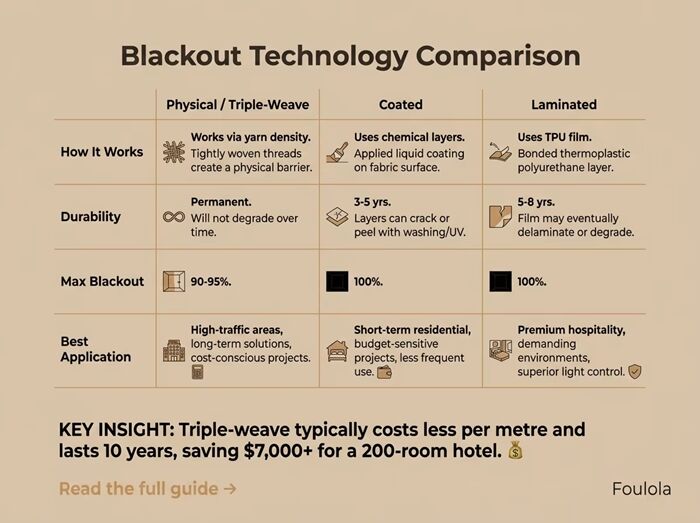
Key insight: Triple-weave physical blackout curtains typically cost less per metre than coated alternatives, but they usually cannot achieve 100% blackout.
If your project requires 100% blackout, choose coated or laminated options. Over a 10-year hotel lifecycle, triple-weave curtains need replacing once, while coated curtains may need replacing three times.
For a 200-room hotel requiring 500 metres of fabric, the total cost of ownership difference can exceed $7,000.
1.3 Flame Retardancy: Know Your Standards
|
Market |
Standard |
Key Requirements |
|
USA |
NFPA 701 |
Vertical flame test for curtains & drapes |
|
UK / Europe |
BS 5867 Type 2 Part C |
Medical-grade FR; stricter than NFPA 701 |
|
Middle East |
Civil Defence codes |
Usually references NFPA 701 or BS standards |
|
Australia |
AS 1530 Part 3 |
Ignitability, flame spread, heat release |
II. Understanding Pattern Options: Why Subtlety Wins in Commercial Projects
From 25 years of supplying hotel projects across 40+ countries, we have observed a clear pattern: over 85% of hotel curtain specifications use solid fabrics or fabrics with subtle,
tone-on-tone patterns. Solid is the safest, most versatile, and least error-prone choice.
2.1 Pattern Selection by Space Type
|
Space Type |
Primary Choice |
Secondary Choice |
Why |
|
Hotel Guest Rooms |
Solid |
Subtle jacquard, tone-on-tone embossed |
Solid is safest and most versatile |
|
Hotel Lobbies |
Solid |
Subtle woven-in motif, soft geometric jacquard |
Solid doesn't overwhelm the space |
|
Corridors |
Solid (with texture) |
--- |
Durability and consistency over style |
|
Restaurants / Bars |
Solid |
Slightly bolder embossed or printed accents |
Solid is safe; feature spaces can experiment |
|
Hospitals / Care Homes |
Solid (Class A eco-certified) |
--- |
Safety and hygiene over aesthetics |
|
Private Studies |
Solid |
Subtle jacquard, understated motifs |
Solid brings quietness; jacquard rewards attention |
III. Prepare a Specification Document Your Supplier Can Actually Use
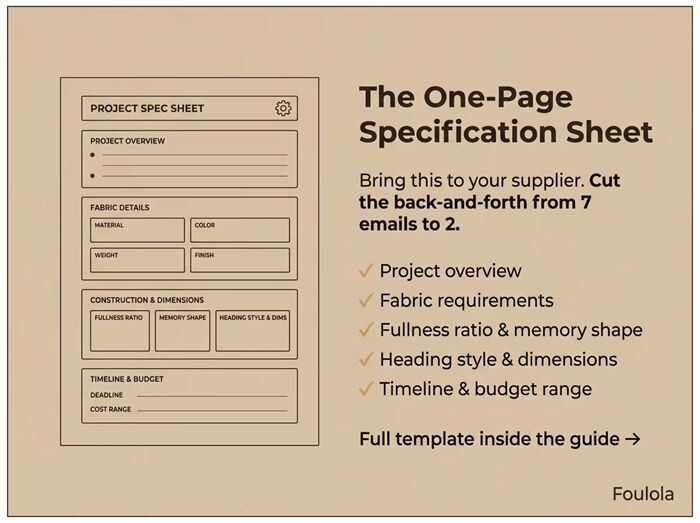
The single most valuable document you can bring to a supplier conversation is a one-page specification sheet. Based on our analysis of inquiries received over 25 years, a well-prepared spec sheet reduces the average back-and-forth from 7 emails to 2.
3.1 The One-Page Specification Template
|
Section |
Key Fields |
Example |
|
Project Overview |
Space type, number of rooms, new build/renovation |
200-room hotel, renovation, guest rooms only |
|
Fabric Requirements |
Blackout %, FR standard, acoustic need, GSM preference, fabric style |
90–95% blackout, NFPA 701, moderate acoustic, 300+ GSM, solid/jacquard |
|
Fullness Ratio |
2.0x / 2.5x / 3.0x |
2.5x (standard fullness) |
|
Memory Shape |
Required or not |
☐ Required ☐ Not required |
|
Heading Style |
Style, triple pinch/double pinch |
Pinch pleat (double) |
|
Dimensions |
Window or finished curtain? Labelled by room? |
Finished curtain, labelled by room number |
|
Quantity |
Sets or panels |
500 sets / 400 panels |
|
Timeline |
Sample needed by, delivery needed by |
Samples: 15 June; Delivery: 30 August |
|
Budget Range |
Per-metre or per-room range |
Per-metre or per-room range |
3.2 Measurement Protocol
|
Measurement Type |
How to Measure |
Common Error |
|
Standard Window |
Measure width and drop from rod/track |
Measuring from window frame instead of rod |
|
Floor-to-Ceiling |
Measure from rod/track to floor, minus 1–2cm clearance |
Forgetting clearance; curtain drags on floor |
|
Bay Window |
Measure each section separately; specify if continuous track |
Assuming all sections are equal width |
|
Multiple Rooms |
Label each room; create a spreadsheet |
Mixing up room numbers during installation |
IV. The Sample: Your Most Important Decision Point
We cannot overstate this: never skip the sample stage. A pre-production sample is a single finished curtain or fabric swatch made to your exact specification. It is your last chance to verify everything before bulk production begins.
4.1 What to Check When You Receive a Sample
|
Check |
How to Verify |
Red Flag |
|
GSM Accuracy |
Weigh a 1m × 1m section on a digital scale |
More than 5% deviation from specification |
|
Colour Under Natural Light |
View by window at midday |
Significant colour deviation from expectation |
|
Colour Under Artificial Light |
View under hotel room lighting conditions |
Visual perception differs too much from natural light |
|
Drape |
Hang on a rod for 24 hours; photograph |
Doesn't hold folds; appears limp or stiff |
|
Blackout Performance |
Hold against bright sunlight or a torch |
Pinhole light leaks or uneven shading |
|
FR Verification |
Request test report, not just certificate |
Supplier can't provide batch-specific test data |
|
Seam & Hem Quality |
Inspect stitching density and straightness |
Loose threads, uneven hems, wavy seams |
|
Fullness Effect |
Confirm pleat fullness matches your chosen ratio |
Pleats too sparse or too crowded |
|
Memory Shape Effect |
If selected, check wave pattern uniformity and durability |
Waves uneven or don't recover after parting |
4.2 Sample Turnaround: What to Expect
|
Supplier Type |
Typical Sample Turnaround |
Implication |
|
Organised Manufacturer |
3–7 days |
Responsive team; organised production line |
|
Trading Company |
2–4 weeks |
Relies on third-party factories; less control |
|
Slow Responder |
3+ weeks or no clear timeline |
Red flag; walk away |
Practical Note: Some manufacturers — particularly those keeping most fabrics in ready stock — support showroom sampling.
This means they can produce sample curtains for your model room without requiring a full roll MOQ. If this is important to your project timeline, ask about it during your initial inquiry.
V. Start Small, Then Scale: The Pilot Order Strategy
We often see procurement managers trying to get everything perfect on the first order. The pressure is understandable — projects have deadlines, budgets are fixed, and mistakes are costly.
But here's a counterintuitive principle: your first order should be a pilot, not a finale.
5.1 The Pilot Order Framework
|
Step |
Action |
Timeline |
|
1. Showroom Sample |
Order 1–2 sample curtains for your model room |
Week 1 |
|
2. Live Test |
Hang them; observe light at different times; wash once if applicable |
Week 2–3 |
|
3. Feedback Loop |
Share observations with supplier; request adjustments if needed |
Week 3–4 |
|
4. Pilot Order |
Order for 5–10 rooms first |
Week 5 |
|
5. Full Rollout |
Scale to all rooms |
Week 8+ |
This approach costs a little more time upfront but has been proven to reduce post-installation issues by over 70% in multi-room hospitality projects.
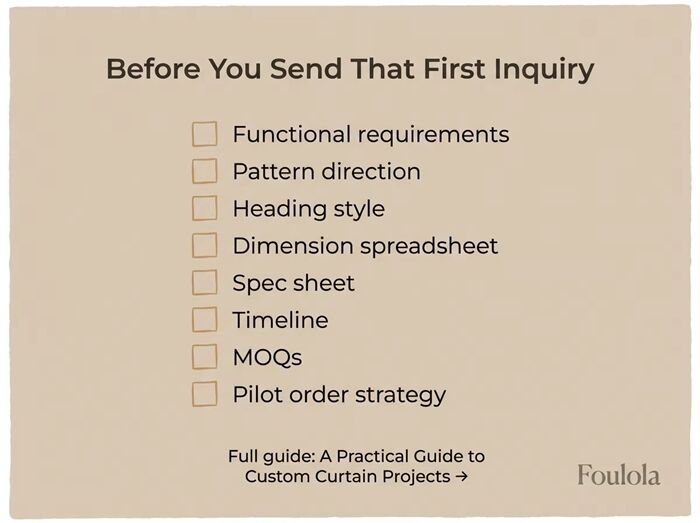
VI. Summary Checklist: Before You Send That First Inquiry
☐ Functional requirements defined and documented (blackout level, FR standard, acoustic needs, eco certification, fullness ratio, memory shape)
☐ Pattern direction confirmed (solid as primary choice, or subtle jacquard, tone-on-tone embossed)
☐ Heading style selected with visual reference
☐ Dimension spreadsheet prepared, labelled by room
☐ One-page specification sheet completed
☐ Sample timeline discussed with supplier
☐ MOQ, lead time, and treatment compatibility confirmed
☐ Pilot order strategy planned
How Foulola Approaches Custom Projects
We don't expect every reader of this guide to work with us. But if you've made it this far, here is a summary of our custom capabilities:
• Custom Curtains: We keep most fabrics in ready stock and support showroom sampling — sample curtains for your model room without full roll MOQ.
Finished curtains are manufactured to your measurements and packaged by room. We handle cutting, sewing, and QC. You handle local installation.
• Functional Finishing: Industrial-grade FR (NFPA 701, from 1 roll), antibacterial, water-proof, stain-resistant, and fragrance treatments.
Other functions from 10 rolls — mix patterns, mix colours. FR and water-proof cannot be combined on the same fabric. Showroom sampling for treated curtains is also supported.
Every project starts with a conversation. Tell us what you're working on. We'll tell you what's possible.
Table of Contents
- I. Define What You Really Need: A Functional Requirements Framework
- II. Understanding Pattern Options: Why Subtlety Wins in Commercial Projects
- III. Prepare a Specification Document Your Supplier Can Actually Use
- IV. The Sample: Your Most Important Decision Point
- V. Start Small, Then Scale: The Pilot Order Strategy
- VI. Summary Checklist: Before You Send That First Inquiry
- How Foulola Approaches Custom Projects

