
 EN
EN

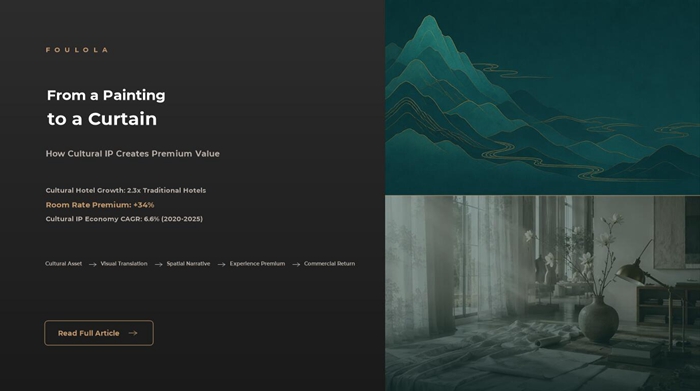
Why Can Two Visually Identical Curtain Fabrics Differ by Double in Price?
By Foulola Product Team | 25 Years of Curtain Fabric Manufacturing
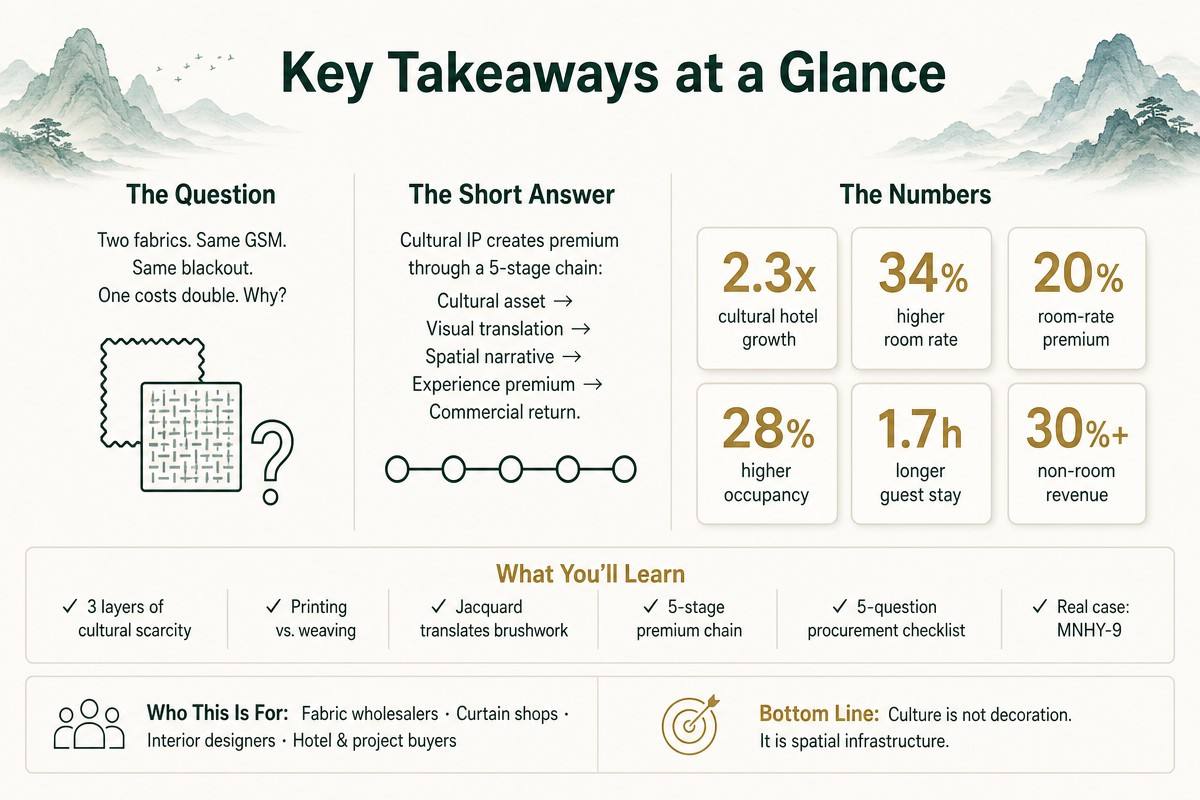
If you only remember one thing: the premium is not for the pattern—it's for the cultural asset woven into the guest experience. Below, we break down the 5-stage premium chain, printing vs. weaving, and the 5 questions procurement should ask.
1. Why Can One Curtain Fabric Cost Double Another?
This is the most common scenario a procurement manager faces.
Two fabrics on the table. Similar GSM. Same blackout rate. Both pass flame retardant testing. One is a solid plain weave, quoted at $20 per meter. The other is inspired by Wang Ximeng's *A Thousand Li of Rivers and Mountains* from the Northern Song Dynasty, with blue-green landscape motifs subtly emerging, quoted at $40 per meter.
Double the price. Your boss asks: Why?
There's no one-sentence answer, but there is a logic you can calculate. To understand why cultural IP curtains can cost more, you need to clarify three things: how much cultural symbols are worth, how a painting becomes a piece of fabric, and what it creates for the hotel.
2. Why Can Curtains with a Cultural Story Sell for More?
2.1 The "Expense" of Cultural IP Lies in Three Types of Scarcity
The premium power of cultural IP comes first from scarcity. But scarcity isn't just one thing; it consists of three layers.
Layer One: The original is rarely seen. The original A Thousand Li of Rivers and Mountains is housed in the Palace Museum. Because the silk is fragile, it has been exhibited only once in the past decade. The less you can see it, the more you want to. The same logic applies in business: any derivative inspired by it naturally carries the gene of being "not something everyone has."
Layer Two: Recognizable at a glance. The azurite and malachite of blue-green landscape painting have extremely high color recognition. When guests see mountain motifs on a curtain, they know where it comes from without any text explanation. For hotels, this means the cost of building brand memory is extremely low.
Layer Three: The story cannot be copied. The author, Wang Ximeng, finished this painting at eighteen, and then disappeared from historical records. This story of a "young genius, one painting for eternity" cannot be copied by others. Hotel brands can use it directly.
2.2 How Does Scarcity Turn into Money?
Scarcity alone isn't enough. It must pass through a transmission chain to become a premium the hotel can price.
When cultural symbols enter a space, they do two things: make the space "different," and make guests feel "cultured." Together, these two things are the source of the premium.
Data can illustrate the point:
| Indicator | Data |
|---|---|
| Growth rate of Chinese cultural-themed hotels (since 2023) | 2.3x that of traditional hotels |
| Average room rate of cultural-themed hotels | 34% higher than traditional hotels |
| Room rate premium for cultural-themed rooms | 20% |
| Non-weekend occupancy increase | 28% |
| Average guest stay extension | 1.7 hours |
| Non-room revenue growth (F&B, cultural merchandise) | Over 30% |
These numbers show one thing: the premium for cultural IP curtains is not built from cost. It's the extra money the hotel can charge after the spatial experience is upgraded.
3. What's the Difference Between a Pattern "Printed" On and "Woven" In?
3.1 What's the Real Difference Between Printing and Weaving?
There are two paths for a pattern to enter fabric.
Printing places the pattern "on" the surface of the fabric. Low cost, fast speed, but the pattern is attached to the surface. It may fade after repeated washing.
Weaving "knits" the pattern into the fabric structure. The pattern is part of the fabric itself—it won't fade, won't peel, won't age.
For hotel projects, which one to choose depends on a very practical question: How many times will this curtain be washed?
After 30 washes, a printed fabric may have already faded somewhat. With jacquard weaving, the pattern lives in the structure. No matter how many times it's washed, it's still there.
3.2 What Makes Jacquard Weaving So Difficult?
Jacquard is a technique that interlaces warp and weft threads according to specific rules to create raised patterns. Its difficulty lies in the high level of craftsmanship required.
There's another notable change: thirty years ago, Chinese jacquard looms mainly wove European and American patterns. Today, the same machines are weaving traditional Chinese motifs. This shift itself is the foundation for the scalable production of cultural IP curtains.
3.3 Without Metallic Threads, How Do You Weave the Layered Feel of a Landscape?
A Thousand Li of Rivers and Mountains is beautiful because of the layering of its pigments—the variations of azurite and malachite on silk, and the sense of distance between mountains.
This layering, when woven into fabric, does not rely on metallic threads. It relies on yarns of different lustre. Matte yarns absorb light, bright yarns reflect it, and semi-bright yarns transition in between. When these yarns are interlaced in a jacquard structure, light hits them and naturally creates contrast and depth.
For procurement, this means the realization of cultural patterns doesn't depend on special materials, but on yarn combinations and weaving precision. Costs are controllable, and the supply chain is stable.
4. Which Cultural Patterns Sell Best on Curtains?
Not all cultural IPs sell equally well. Different types of IP have very different premium capabilities. The table below can help you judge priorities.
| Cultural IP Type | Representative Examples | How Premium Is Created | Suitable Spaces | Premium Elasticity |
|---|---|---|---|---|
| Painting/Calligraphy | A Thousand Li of Rivers and Mountains, Lantingji Xu | Recognized at a glance → has a story → immersion | Boutique hotels, resorts, cultural theme hotels | High |
| Architecture/Gardens | Suzhou gardens, traditional dwellings | Spatial form → architectural language → sense of place | Resort hotels, cultural tourism complexes | Medium-high |
| Intangible Cultural Heritage Crafts | Polished lacquer, Jiexiu glazed ware | Craft story → tactile experience → scarcity | High-end hotels, cultural spaces | Medium |
| Music/Opera | Yue opera, Kunqu opera | Auditory atmosphere → emotion → immersion | Boutique hotels, cultural theme spaces | Medium |
| Natural Landscapes | Lugu Lake, Huangshan | Geographic scarcity → landscape possession → resort feel | Resort hotels, wellness hotels | High |
Advice for procurement:
-
If the project is positioned as a cultural theme hotel, painting-type IP has the highest recognition and the largest premium space.
-
If the project itself has architectural or landscape advantages, natural landscape IP is the easiest to apply.
-
Intangible cultural heritage IP has a higher cognitive threshold and suits high-end projects with interpretive support.
5. What 5 Questions Should Procurement Ask When Choosing Cultural IP Curtains?
Based on the analysis above, procurement can use these 5 questions to judge whether a cultural IP curtain is worth buying.
Question One: Is the project's cultural theme clear?
If the project itself has no cultural positioning, a cultural IP curtain is just an isolated decoration and cannot support systematic premium.
Question Two: Can guests recognize where the pattern comes from within 3 seconds?
Highly recognizable patterns (such as blue-green landscapes) are more likely to form brand memory than abstract patterns.
Question Three: Is the pattern printed or woven?
Hotel projects require frequent washing. Jacquard weaving is the more reliable choice.
Question Four: Have you calculated the total lifecycle cost?
Printed fabrics may have an initial cost 30–50% lower, but may need replacing after multiple washes. Woven fabrics require higher upfront investment but last longer.
Question Five: How wide can the supplier go?
Cultural patterns need to unfold completely. If the fabric isn't wide enough, splicing will destroy the continuity of the pattern. A width capability of 3.0 meters and above is the basic threshold for cultural IP curtains.
6. A Real Case: How Was A Thousand Li of Rivers and Mountains Woven into a Curtain?
In jacquard products, one approach is particularly noteworthy: weaving cultural patterns directly into the fabric structure rather than printing them on the surface.
Take Foulola's MNHY-9 series as an example. Inspired by A Thousand Li of Rivers and Mountains, this product uses jacquard weaving to reproduce the landscape on a lightweight 153gsm sheer.
Key parameters:
-
3.0-meter finished width — the landscape scroll can unfold completely across a single window panel without splicing
-
Interlacing of yarns with different lustre — the pattern shows layered variation under different lighting conditions
-
153gsm weight — enough drape, while filtering daylight into a soft, warm glow
The product comes in three colors: Off-White corresponds to "plain silk awaiting ink," Light Beige to "the warm yellow of aged rice paper," and Light Grey to "the blue-grey of mountains in mist."
This case shows that for cultural IP to be woven into fabric, three conditions must be met simultaneously: wide enough (to ensure the image is complete), precise enough (to ensure pattern fidelity), and the right yarns (to ensure light layering).
7. From a Painting to Hotel Room Rates: How Is the Premium for Cultural IP Curtains Created?
Connecting the analysis above, cultural IP creates premium for hotel soft furnishings in five steps:
Cultural asset → Visual translation → Spatial narrative → Experience premium → Commercial return
Each step requires corresponding inputs and capabilities:
| Stage | What to Invest | What Capability Is Needed | What Is Produced |
|---|---|---|---|
| Cultural asset | IP licensing / cultural research | Understanding culture, ability to select | Convertible symbols |
| Visual translation | Design development / craft R&D | Cross-media translation | Mass-producible patterns |
| Spatial narrative | Soft furnishing integration / spatial design | Spatial narrative capability | Immersive experience |
| Experience premium | Operational support / service design | Experience management | Room rate premium and non-room revenue |
| Commercial return | Continuous iteration / brand building | Content operation | Brand equity and repeat purchase |
Key conclusion: The premium for cultural IP does not happen automatically. If any of the five stages is missing, the cultural value is discounted.
8. Conclusion: Are Cultural IP Curtains a Cost or an Investment?
Back to the opening question: Why can one curtain fabric cost double another?
The answer depends on how you see the money.
If you see it as a cost, $40 is double $20, and you have to explain the difference.
If you see it as an investment, the question changes: How much more can this fabric help the hotel earn?
The data is there: 20% room rate premium for cultural-themed rooms, 28% higher non-weekend occupancy, guests staying 1.7 hours longer, and over 30% growth in non-room revenue. These are the values created by cultural IP curtains as "spatial infrastructure."
For fabric wholesalers and curtain shops, this means a clear product strategy: cultural IP fabrics are not a replacement for ordinary blackout fabric. They are an independent category, sold to project clients who have requirements for spatial experience.
For designers and hotel procurement, this means an upgrade in procurement standards: choosing a cultural IP curtain is not "picking a nice-looking fabric," but treating it as a functional component within the spatial experience system—just like blackout, acoustics, and durability, it needs serious planning.
China's cultural and creative products industry reached 99.982 billion RMB in 2024, and the museum cultural IP economy achieved a compound annual growth rate of 6.6% from 2020 to 2025. This market is still growing, indicating that cultural IP is not a passing trend but a structural trend that is taking shape.
In this trend, the most competitive spaces are not those with the most cultural symbols, but those that best understand how to "weave" cultural symbols into the fabric of space. When culture moves from decoration to infrastructure, the value anchor of hotel soft furnishings shifts from material cost to the capacity for cultural narrative itself.
The market data cited in this article are drawn from publicly available industry reports and news sources. Product technical parameters are drawn from Foulola production documents. The MNHY-9 series mentioned is an actual product currently on sale; its layered effect is achieved through jacquard interlacing of yarns with different lustre, and the relevant technical details may be referenced by project buyers.
Table of Contents
- 1. Why Can One Curtain Fabric Cost Double Another?
- 2. Why Can Curtains with a Cultural Story Sell for More?
- 3. What's the Difference Between a Pattern "Printed" On and "Woven" In?
- 4. Which Cultural Patterns Sell Best on Curtains?
- 5. What 5 Questions Should Procurement Ask When Choosing Cultural IP Curtains?
- 6. A Real Case: How Was A Thousand Li of Rivers and Mountains Woven into a Curtain?
- 7. From a Painting to Hotel Room Rates: How Is the Premium for Cultural IP Curtains Created?
- 8. Conclusion: Are Cultural IP Curtains a Cost or an Investment?

