
 EN
EN

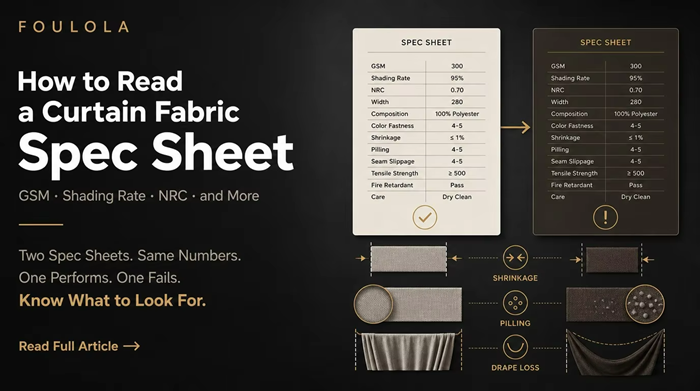
How to Read a Curtain Fabric Spec Sheet: What GSM, Shading Rate, NRC, and Color Fastness Really Tell You
A No-Nonsense Procurement Guide for Fabric Wholesalers, Curtain Shops, Interior Designers, and Hotel Buyers
By Foulola Product Team | 25 Years of Curtain Fabric Manufacturing
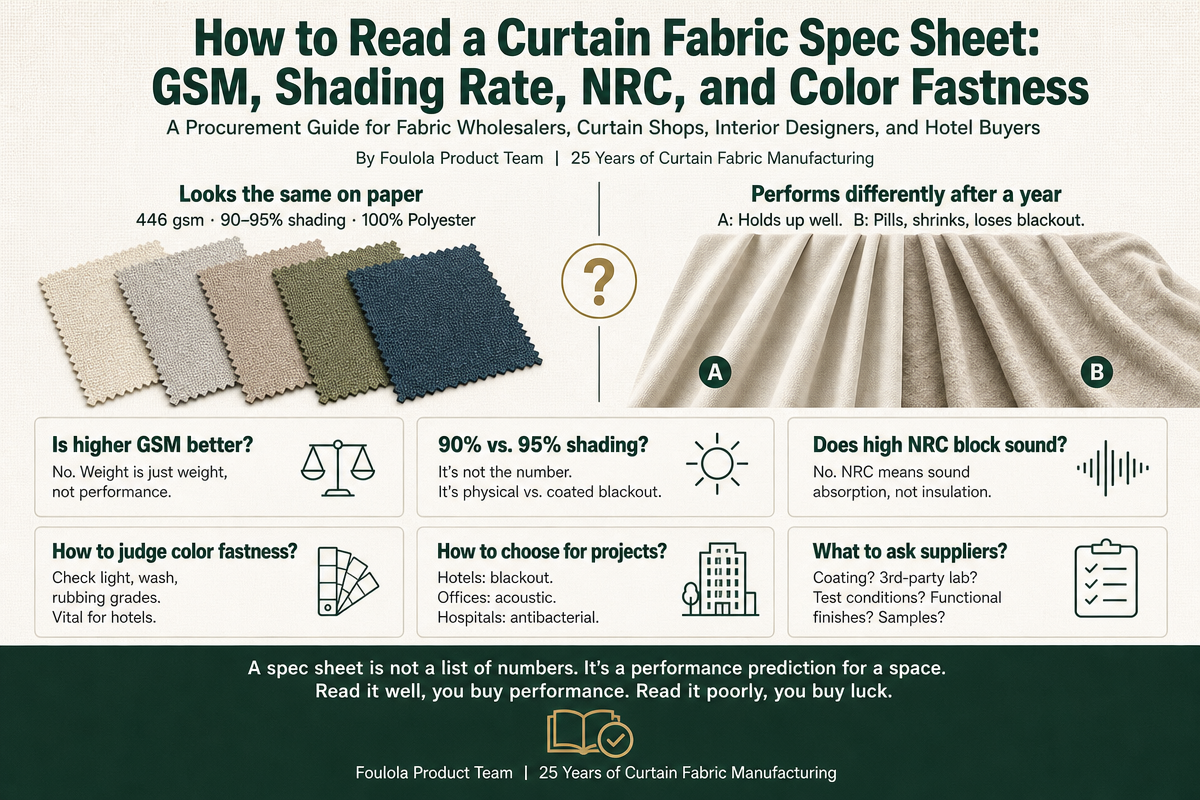
If you only remember one thing: don't judge a curtain fabric by a single spec. The article below breaks down GSM, shading rate, NRC, and color fastness, and how to match them to your specific project.
1. Why Do Two Fabrics with the Same Specs Perform So Differently?
Here's a scenario that plays out in procurement offices every week.
Two suppliers submit spec sheets. Fabric A and Fabric B. Both say:
-
Weight: 446 gsm
-
Shading rate: 90–95%
-
Composition: 100% polyester
-
Structure: triple weave
On paper, they look interchangeable. The price is similar. You might even think it doesn't matter which one you choose.
But fast forward one year into a hotel project. The difference shows up.
Fabric A still hangs beautifully. The blackout performance holds up. Guests sleep well. Housekeeping has no complaints.
Fabric B? It shrank after the third wash. The surface pills. The acoustic performance dropped noticeably. Now you're dealing with replacement costs, unhappy clients, and a supplier who points to the spec sheet and says:
"But it meets the specs."
So where does the problem lie?
The answer is usually hidden behind parameters that look familiar but are widely misunderstood. GSM, shading rate, NRC, color fastness, airflow resistance—these aren't just numbers on a page. They're quantified expressions of how a fabric will actually behave in the real world. And if you don't know how to interpret them—or how they constrain each other—you're essentially gambling with your project budget.
This article breaks down the most critical technical parameters in curtain fabric spec sheets. For each one, we'll cover: what it actually means, how it's measured, what people commonly get wrong, and how to match it to your project requirements. We'll use real production examples for illustration, but the goal here isn't to sell you any specific product—it's to help you build the ability to judge for yourself.
Because ultimately, the best procurement decision is an informed one.
2. GSM: Does Heavier Always Mean Better?
2.1 What GSM Actually Measures
GSM stands for Grams per Square Meter. It's the mass of fabric per unit area.
The measurement follows ISO 3801. You take samples from different positions of the fabric, condition them under standard temperature and humidity, weigh them, and convert to grams per square meter.
Here's the misconception that trips people up: higher GSM does not automatically mean better fabric.
GSM is a weight indicator. That's it. It tells you how heavy the fabric is. It does not directly tell you how well it blocks light, how much sound it absorbs, or how long it will last. Those are separate questions with separate answers.
2.2 Why Two Fabrics with the Same GSM Can Perform Completely Differently
A fabric's functional performance depends on multiple factors: yarn type, weave structure, finishing processes. Two fabrics can weigh exactly the same but behave like completely different products.
Take a 393 gsm slub jacquard fabric and a 393 gsm plain weave fabric. Same weight. But the jacquard's three-dimensional texture scatters sound waves, while the plain weave's smooth surface reflects more sound. The drape is different. The hand feel is different. The acoustic performance is different.
This is why you can't just look at GSM and make a decision. It's a starting point, not a conclusion.
2.3 GSM Reference Ranges for Commercial Procurement
Here's a practical reference table for common curtain applications:
| Application | Common GSM Range | Selection Logic |
|---|---|---|
| Sheer curtains | 100–200 | Lightweight, light-transmitting, emphasis on drape and natural light filtration |
| Standard blackout curtains | 250–350 | Balance between blackout, drape, and cost |
| Mid-to-high blackout curtains | 350–450 | Mainstream choice for hotel guest rooms and office spaces |
| Heavyweight blackout curtains | 450–550 | Emphasis on acoustic, thermal, and luxurious drape; suitable for high-end projects |
One important note: GSM should only serve as an initial screening condition. It is not the final basis for decision-making. When a project has clear requirements for acoustic insulation, thermal performance, or blackout, you need to look at other parameters comprehensively.
3. Shading Rate: What's the Real Difference Between 90% and 95%?
3.1 What Shading Rate Actually Means
Shading rate (also called blackout percentage) indicates how well a fabric blocks visible light.
Testing typically follows EN 14500 or AATCC 148. A spectrophotometer measures the proportion of luminous flux transmitted through the fabric.
So when you see "90–95% shading," it means the fabric blocks 90% to 95% of visible light. The higher the number, the darker the room.
But here's where it gets interesting.
3.2 Physical Blackout vs. Coated Blackout: The Difference That Matters
How a fabric achieves its blackout performance directly affects durability and hand feel. This is one of the most important distinctions in commercial procurement.
| Type | Method | Advantages | Disadvantages |
|---|---|---|---|
| Physical blackout | Triple weave with a high-density black yarn middle layer | Wash-resistant, breathable, good hand feel, eco-friendly | Higher cost; higher demands on weaving technology |
| Coated blackout | Coating the back of the fabric with blackout material | Low cost, high shading rate | May peel after repeated washing; poor breathability; stiff hand feel |
For commercial projects—especially hotels that require frequent cleaning—physical blackout fabrics are usually the better choice. Even after 30–50 commercial wash cycles, the shading rate of physical blackout fabrics declines far less than that of coated blackout products.
This is exactly the kind of detail that doesn't show up on a basic spec sheet. Both fabrics might say "90–95% shading." But one will still perform after years of service. The other might start peeling after a few months.
3.3 How to Choose the Right Shading Rate for Your Project
For hotel guest rooms, a shading rate above 90% generally meets the sleep needs of most guests.
For environments requiring complete darkness—home theaters, surgical recovery rooms, certain laboratory settings—a shading rate above 99% may be necessary.
But higher shading rates often mean heavier fabrics and higher costs. So the choice should be weighed against actual needs, not just maxed out for the sake of it.
4. NRC: Can Curtains Actually Block Sound?
4.1 What NRC Really Measures
NRC stands for Noise Reduction Coefficient. It's an indicator of a material's sound absorption performance.
The value represents the average of absorption coefficients at 250, 500, 1000, and 2000 Hz. It ranges from 0 to 1. The higher the NRC, the stronger the material's sound absorption capacity.
But here's the critical limitation that many buyers miss: NRC only reflects sound absorption, not sound insulation.
Curtains, as flexible materials, primarily absorb indoor reverberant sound and reduce echo. They do not block sound from entering from outside. That's a different function entirely.
4.2 What Curtains Actually Do for Acoustics
In architectural acoustics, curtains are classified as "sound-absorbing materials," not "sound-insulating materials."
Their primary value lies in:
-
Reducing indoor reverberation time and improving speech intelligibility
-
Reducing sound reflection within a space, creating a sense of quiet
-
Providing some attenuation of high-frequency noise (traffic sounds, human voices)
Key factors affecting a curtain's sound absorption include fabric thickness, density, surface structure, and the distance between the curtain and the wall (the air gap). In general, curtains installed 5–10 cm away from the wall show significantly improved low-frequency absorption.
4.3 The Question You Should Be Asking
Many buyers ask, "What is the NRC of this curtain? Can it block sound?"
That's a misdirected question. It's like asking how much a car's air conditioning system improves its fuel efficiency—they're related to the same vehicle, but they're different systems.
The correct question is: "Under a specific installation method, how much reverberation improvement can this curtain bring to the space?"
NRC data provided by fabric suppliers is usually measured under standard laboratory conditions. It may differ from actual on-site performance. So NRC data is more suitable for horizontal comparison between different fabrics than for directly predicting actual sound insulation effects.
5. Color Fastness: How Long Will the Color Really Last?
5.1 What Color Fastness Means and How It's Graded
Color fastness indicates how well a fabric's color remains stable under conditions like light, washing, and friction.
Common indicators:
-
Light fastness: Tested according to ISO 105-B02, graded 1–8. Higher is better.
-
Washing fastness: Tested according to ISO 105-C06, graded 1–5.
-
Rubbing fastness: Divided into dry rubbing and wet rubbing, graded 1–5.
Commercial curtain fabrics are generally expected to achieve a light fastness of grade 4 or above and a washing fastness of grade 4 or above.
For dark-colored fabrics—especially in hotel projects with frequent cleaning—color fastness indicators are particularly important. A fabric that fades after a few months of sunlight exposure is not a good investment, no matter how good it looked in the showroom.
5.2 Why Fabric Structure Affects Color Fastness
Color fastness depends not only on dye quality but also on fabric structure and yarn type.
For example, the pile surface of chenille yarn is more prone to color transfer under friction. So the wet rubbing fastness of chenille fabrics is often lower than that of plain weave fabrics.
But this doesn't mean chenille fabrics are unsuitable for commercial use. It simply means appropriate care should be taken during cleaning and use. Understanding this relationship helps you set realistic expectations and communicate them to your clients.
6. The Trade-Offs: Is There Such a Thing as a Perfect Fabric?
In actual procurement, there are often trade-offs among parameters. You can't max out everything.
Here's a simplified relationship matrix:
| Desired Performance | Possible Trade-off |
|---|---|
| High GSM (heavier) | Higher cost, increased track load requirements, heavier pull feel |
| High shading rate (darker) | Heavier fabric, potentially limited color options |
| High sound absorption (high NRC) | Increased thickness, possible reduction in drape, increased cleaning difficulty |
| High color fastness | Some vibrant colors may be difficult to achieve, increased cost |
So selecting curtain fabric is not about pursuing the highest values across all parameters. It's about finding the balance point that best matches your project requirements.
This is where experienced buyers differentiate themselves from beginners. They know what to prioritize and what to compromise on.
7. Matching Spec Sheets to Your Project: What Should You Prioritize?
7.1 Project Type and Priority Parameters
Different projects have different requirements. Here's a practical guide:
| Project Type | Priority Parameters | Reasons |
|---|---|---|
| Hotel guest room | Shading rate, color fastness, durability | Frequent cleaning; guests have a hard requirement for dark environments |
| Office space | Sound absorption, flame retardancy | Open spaces need reverberation reduction while meeting fire codes |
| Hospital / care facility | Antibacterial function, ease of cleaning, flame retardancy | High hygiene standards and strict safety requirements |
| High-end residence | Drape, texture, color | Greater emphasis on tactile and visual luxury |
7.2 Questions You Should Always Ask Your Supplier
When requesting spec sheets from suppliers, don't just compare numbers. Ask these questions:
-
Is the blackout performance achieved through physical blackout or coating?
-
Are the test data from a third-party laboratory or internal testing?
-
Under what test conditions were the color fastness grades obtained?
-
If functional finishing (such as flame retardancy or antibacterial treatment) is required, will it affect other parameters?
-
Can the supplier provide samples for on-site testing?
These questions reveal the true performance of fabrics far better than simply comparing GSM or shading rate numbers.
A supplier who can answer these questions clearly and confidently is a supplier worth working with. One who can't—well, that tells you something too.
8. Real-World Examples: How Specs Play Out in Actual Fabrics
Let's look at three types of curtain fabrics currently in production to see how parameters guide selection in practice. We're using these examples not to push any particular product, but to show you how the same GSM and shading rate can produce very different results depending on structure.
| Fabric Type | GSM | Shading Rate | Structural Features | Suitable Application |
|---|---|---|---|---|
| Striped Slub Cotton Style Blackout Curtain | 393 | 90–95% | Jacquard slub texture, double-sided | Hotel guest rooms and office spaces; emphasis on natural texture and acoustic scattering |
| Scratch-Resistant Plain Weave Blackout Curtain | 446 | 90–95% | Plain weave, smooth and wear-resistant surface | High-traffic commercial areas; emphasis on easy cleaning and durability |
| Luxury Chenille Abstract Jacquard Blackout Curtain | 464 | 90–95% | Chenille pile + jacquard | High-end hotel public areas and luxury residences; emphasis on tactile feel and visual depth |
These fabrics have similar GSM and shading rates. But due to different weave structures, they show clear differences in acoustic performance, drape, abrasion resistance, and maintenance requirements.
This is a real-world demonstration that you cannot judge a spec sheet by a single line of numbers. The structure behind the numbers matters just as much.
9. Conclusion: Read the Spec Sheet as a Performance Prediction
For project decision-makers in commercial spaces, a curtain fabric spec sheet should not be treated as a simple list of technical data. It should be read as a predictive document for spatial performance.
Here's how to think about it:
-
GSM tells you the weight of the fabric, but you need to ask how it affects drape and track load.
-
Shading rate tells you how dark the room will be, but you need to confirm whether it's physical blackout or coated blackout.
-
NRC tells you the sound absorption capacity, but you need to understand that it is not the same as sound insulation.
-
Color fastness tells you how long the color will last, but you need to combine it with cleaning frequency to judge actual lifespan.
Ultimately, a reliable curtain spec sheet should give you the ability to make an informed choice between two seemingly identical products. It helps you avoid the procurement trap of products that "look fine on paper but cause endless problems in use."
When procurement decisions evolve from "comparing numbers" to "understanding performance," curtains cease to be just a piece of fabric. They become a functional component within a building's indoor environmental management system.
And that's when you start making decisions that hold up—not just in the showroom, but after years of real-world use.
The parameter descriptions in this article are based on relevant standards such as ISO, EN, and AATCC. The fabric parameters mentioned are typical values from actual Foulola production and are provided as reference examples. For specific project selection, formal test reports and physical samples should be used as the final basis.
About the Foulola Product Team
We've been manufacturing curtain fabrics for 25 years. In that time, we've seen every mistake buyers can make—and made a few ourselves. This article is part of our effort to share what we've learned so that procurement professionals can make better decisions, whether they buy from us or not. If you have questions about a specific project, feel free to reach out. We're happy to talk through the technical details.
Table of Contents
- 1. Why Do Two Fabrics with the Same Specs Perform So Differently?
- 2. GSM: Does Heavier Always Mean Better?
- 3. Shading Rate: What's the Real Difference Between 90% and 95%?
- 4. NRC: Can Curtains Actually Block Sound?
- 5. Color Fastness: How Long Will the Color Really Last?
- 6. The Trade-Offs: Is There Such a Thing as a Perfect Fabric?
- 7. Matching Spec Sheets to Your Project: What Should You Prioritize?
- 8. Real-World Examples: How Specs Play Out in Actual Fabrics
- 9. Conclusion: Read the Spec Sheet as a Performance Prediction

