
 EN

Curtain Fabric Pricing: Meter vs. Square Meter & the Hidden Area Calculation Traps
A Practical Guide for Fabric Wholesalers, Curtain Shops, Interior Designers, and Hotel Buyers
By Foulola Product Team | 25 Years of Curtain Fabric Manufacturing
If you only remember one thing: the number you compare on a quote is rarely the number of fabric you actually get in the finished curtain. The article below explains the two pricing systems, the three types of consumption that get buried in the fine print, and the one template you need to compare quotes fairly.
1. Why Does a "Cheaper" Quote Usually Cost You More?
Let's look at a real dispute.
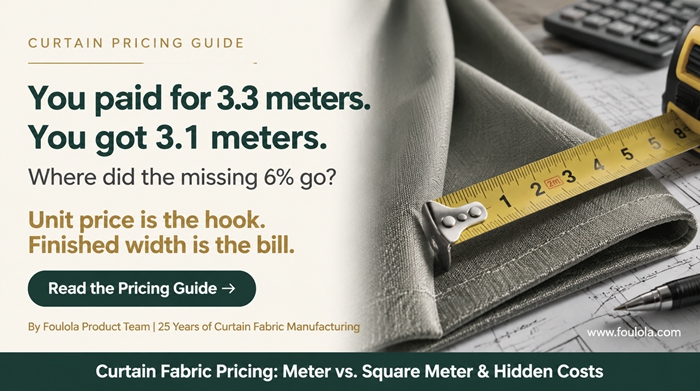
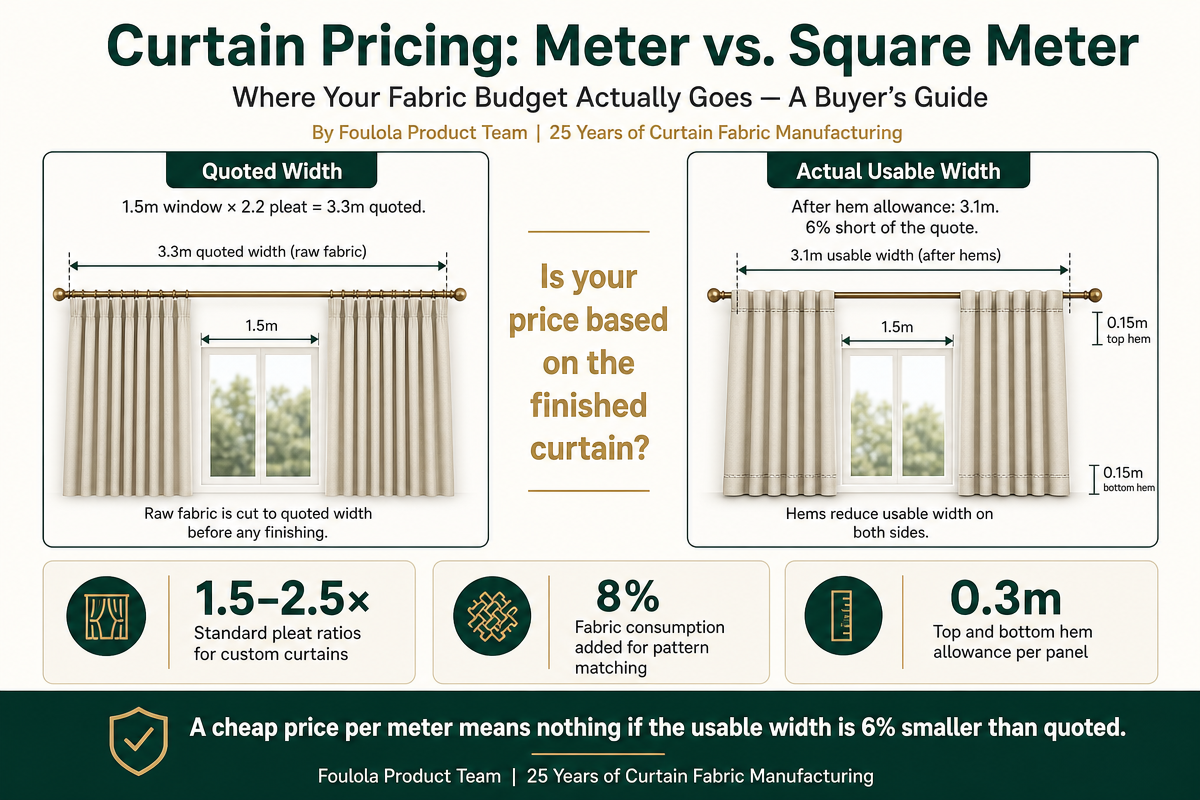
A buyer ordered a 1.5-meter half-curtain. The supplier quoted based on a 2.2× pleat ratio, which means the theoretical fabric consumption should be 1.5 × 2.2 = 3.3 meters. When the fabric arrived, the actual remaining usable fabric was only 3.1 meters. After deducting the necessary hem allowance, it was about 0.2 meters short—meaning the actual usable amount was about 6% less than what was quoted.
The supplier's explanation: hemming and processing consume fabric. The buyer's question: if you quote 3.3 meters and I get 3.1 meters of usable width, is that 6% difference eaten by the process, or hidden by the pricing method?
The core of this dispute isn't about one supplier "cutting corners." It exposes a structural information asymmetry in custom curtain pricing: the buyer sees "width × multiplier × unit price," but what ultimately determines the finished curtain is a set of deduction and loss rules that were never written on the quote.
For fabric wholesalers and curtain shops, understanding these rules determines whether you are selling fabric, or selling a quote that "looks cheap but actually costs more." For designers and hotel buyers, it determines whether your budget will spiral out of control at the installation stage.
2. What's the Real Difference Between Meter-Based and Square-Meter-Based Pricing?
Neither pricing method is inherently right or wrong. The problem is that they apply to different scenarios, and the quote rarely tells you this.
Meter-based pricing (billing by width) is the most mainstream method for custom home curtains. The logic: the height of standard home curtain fabric is usually fixed at 2.8 meters (fixed-height fabric), so fabric consumption in the height direction is locked. Price differences mainly come from how many meters are consumed in the width direction. The calculation: Window width × Pleat ratio × Price per meter.
Square-meter-based pricing charges by the actual surface area. Theoretically fairer: bigger windows cost more, smaller windows cost less. But in custom curtains, the real dispute is "which area is being calculated?" Is it the hung finished area, or the unrolled fabric area? The higher the pleat ratio, the unrolled area can be more than double the hung area. The total price difference between these two definitions can be huge.
| Pricing Method | Core Logic | Common Applications | What to Watch Out For |
|---|---|---|---|
| Meter-based (fixed height, buy width) | Height fixed, width × pleat ratio determines consumption | Custom home curtains, hotel guest room drapes | Whether pleat ratio and losses are included in the quote |
| Square-meter-based | Charged by area, area definition determines total price | Roller blinds, venetian blinds, engineering fabric, irregular windows, large floor-to-ceiling windows | Whether calculated by "hung area" or "unrolled (consumption) area" |
| Per-panel pricing | One price per curtain panel | Standard-size fabric curtains, simple styles | Whether size limits and splicing are charged extra |
A notable fact: many suppliers deliberately use a low square-meter unit price because buyers tend to compare it directly with the meter unit price and think the number looks smaller. But square-meter pricing involves both length and width dimensions, plus differences in pleat and loss definitions. The final total price can easily double.
Buyer takeaway: Never compare unit prices across different pricing methods. A meter-based quote and a square-meter-based quote are only comparable after both are converted to the total cost per window after installation.
3. How Does the Pleat Ratio Turn a "1.5m Window" into a "3.3m Bill"?
The pleat ratio is the most misunderstood variable in custom curtain pricing. It determines how many meters of fabric are needed for the same window.
The industry standard pleat ratio range is 1.8× to 2.5×. 2× is the standard choice for most spaces; 2.2–2.5× is fuller and common in brand stores and light luxury styles; 1.5× is for budget-limited minimalist settings. Some government procurement or engineering project technical specifications explicitly require "pleats not less than two times."
But the key is: "2.2×" refers to the multiplier of the finished width relative to the track or window width, not the fabric utilization efficiency.
Take a 1.5-meter-wide window with a 2.2× pleat as an example:
| Item | Calculation | Result |
|---|---|---|
| Theoretical quoted consumption | 1.5m × 2.2 | 3.3m |
| Side hem consumption (approx. 7cm per side) | 3.3m − 0.14m | 3.16m |
Here's the key cognitive gap: the "3.3m" on the quote is fabric consumption, not the width of the finished curtain. After hemming deductions, the actual usable finished width covering the window may only be 3.1 meters. When the buyer receives this finished product or remaining fabric, the supplier can explain the gap as "hemming and processing consumption." The problem is: if the quote didn't clearly explain the difference between "quoted consumption" and "finished width," the buyer is paying for a deduction rule they were never told about.
An even more hidden layer: Even if the contract says "2× pleat," after deducting the hems, the actual pleat ratio may be lower than 1.8×. Industry analysis points out that for a 2-meter track calculated at 2×, the consumption is 4 meters. After subtracting 4 hems (totaling about 24cm), the actual usable width is 3.76 meters. Relative to the actual coverage requirement of 2.15 meters (including side coverage margin), the pleat ratio is only about 1.75×—already below the usual 1.8× standard. This means the buyer paid for "2× pleat" but received an effect of "less than 1.8×."
4. Besides Pleats, What Other Losses Are Hidden in the Quote?
Pleats are just the first layer of consumption. Hemming, pattern matching, and splicing are three other factors that consume fabric but are rarely itemized on quotes.
Hemming and seams. Every edge of a curtain needs to be hemmed or bound. The finished width of a side hem is usually about 3.5cm; including the folded portion, each side consumes about 7cm of fabric. The top and bottom hems together usually require 0.3m. For a standard pair of curtains, 4 side edges plus 2 top/bottom edges can easily consume over 0.5 meters of fabric. These are usually "included" in the total consumption for meter-based quotes, but buyers are rarely told exactly how much is deducted.
Pattern matching loss. Patterned fabrics must be aligned when spliced. Each panel needs an extra allowance of one "pattern repeat" (common pattern repeat length is 16–35cm). Industry estimates put pattern matching loss at about 8% of total fabric consumption. Solid colors don't need matching, but jacquard, printed, and large-repeat fabrics will significantly increase actual consumption. If the quote doesn't distinguish "solid color price" from "pattern matching price," buyers can easily measure patterned fabric against the price expectation of solid fabric.
Narrow fabric splicing. When using fixed-width fabric (narrow fabric, common width 1.4 meters) to make large curtains, multiple widths must be spliced. Splicing not only adds sewing labor but may further increase consumption due to pattern matching and seam loss. Fixed-height fabric (wide fabric) is bought by width and calculated simply, but only if the window height doesn't exceed the fabric's fixed height (usually 2.8 meters); extra-tall windows still need splicing or extension.
| Loss Type | Industry Reference Value | Usually Itemized on Quote? |
|---|---|---|
| Side hem | Approx. 7cm per side | Rarely |
| Top/bottom hem | 0.3m per panel | Rarely |
| Pattern matching (patterned fabric) | 8% of total fabric consumption | Sometimes vaguely treated as "pattern matching extra" |
| Narrow fabric splicing | Depends on fabric width and window width | Rarely |
Buyer takeaway: Before confirming a quote, require the supplier to itemize: "Quoted consumption → Hem deduction → Pattern matching extra (if any) → Actual finished width." A supplier willing to spell out these four items is far more credible than one who only quotes "how much per meter."
5. How Do You Compare Quotes Fairly? A Template You Can Use Directly
Unit price has no comparability, and total price is easily distorted by losses and deductions. The only fair comparison benchmark is: the actual total cost per window after installation, and the actual finished coverage width obtained per window.
Here is a standardized quote comparison template buyers can ask suppliers to fill out:
| Comparison Dimension | Supplier A | Supplier B | Supplier C |
|---|---|---|---|
| Pricing method | Meter / Sq. Meter | Meter / Sq. Meter | Meter / Sq. Meter |
| Fabric unit price | |||
| Pleat ratio (quoted) | |||
| Quoted consumption (meters) | |||
| Hem/seam deduction (meters) | |||
| Pattern matching extra (meters, if any) | |||
| Finished coverage width (meters) | |||
| Track/accessories/processing fee | |||
| Total landed cost per window | |||
| Actual cost per meter of finished width |
The last row is the key. By using "Total landed cost per window ÷ Finished coverage width," you compress different pricing methods and loss definitions into one comparable unit. If Supplier A's meter unit price is lower, but the finished coverage width is reduced due to larger losses, this row will directly expose the gap.
In addition, three questions must be clarified when comparing quotes:
First, does the quoted "size" refer to the window size, track size, or finished size? If quoted by window size but cut by track size during production, who bears the difference must be confirmed at the quote stage.
Second, is the loss "included in the quote" or "charged separately based on actual usage"? These two expressions can make a big difference at settlement. Require the supplier to clarify: does the consumption number in the quote already deduct hem and pattern matching consumption, and what is the finished width after deduction?
Third, if actual consumption is less than quoted consumption, how is the difference handled? In the case of the 6% gap, the dispute arose precisely because the quote didn't specify the settlement rule for "insufficient consumption." The contract should state: settlement is based on finished coverage width or actual remaining fabric delivered, not solely on the quoted consumption number.
6. A 25-Year Fabric Factory's Observation on Pricing Transparency
Over 25 years of curtain fabric production, Foulola has served two types of clients: those purchasing fabric rolls, and those purchasing finished curtains. These two types have completely different sensitivities to "consumption," but one common need always exists: the deduction rules behind the quote should be explained clearly from the start.
In fixed-size quotes for finished curtains, if only "fabric unit price × quoted consumption" is provided without explaining effective width, hem deduction, and pattern matching extras, there will be a gap between the finished width the buyer receives and the expectation set by the quote. When quoting finished clients, Foulola typically specifies the fabric's effective width and the finished width calculation basis at the same time, so clients know exactly how much coverage width they are getting before confirming the price.
This isn't a competition about "whose unit price is lower." It's a difference in whether a quote can be verified. If you're screening suppliers, ask them to answer one specific question on the quote: "What is the finished coverage width of this curtain in meters, and how much hem and pattern matching were deducted from the quoted consumption?" A supplier who can answer item by item is doing business in a verifiable way. A supplier who only gives a total meterage and a total price leaves the verification responsibility to you.
7. Conclusion: Unit Price Is the Hook, Finished Width Is the Bill
Back to the opening question: meter-based or square-meter-based?
Both methods can be fair. What's unfair is not writing the deduction rules on the quote.
-
Pleat ratio determines quoted consumption, but not finished width. A 2.2× pleat 3.3m quote may result in only 3.1m coverage width after hem deductions.
-
Hemming, pattern matching, and splicing are real consumption, but must be disclosed. Pattern matching loss of 8% isn't an "extra charge"—it's consumption determined by the physical properties of the fabric. The problem is whether it was explained at the quote stage.
-
The only fair comparison unit is "total landed cost per meter of finished width." Don't compare unit prices across pricing methods; convert each quote to the same denominator.
-
Write "subject to finished coverage width or actual remaining fabric delivered" into the contract. If the quoted consumption number has no corresponding finished size agreement, it's just a reference value with no binding force.
On the ledger of custom curtains, the meter unit price is just the hook. What truly determines how much you paid and how much fabric you got is the finished width that was never itemized.
This article is part of Foulola's B2B Educational Series. For technical specifications, finished-width calculations, or sample requests, please visit www.foulola.com or contact your sales representative.
References
Standards and Procurement References:
-
GB 50854-2013, Standard Method of Measurement for Building Construction and Decoration Works — curtain measurement rules.
-
Technical specifications from publicly available government procurement notices for curtain projects, specifying pleat ratio requirements (not less than 2×).
Industry References:
-
Pattern repeat allowance: typically one pattern repeat (16–35 cm) per panel; estimated at 8% of total fabric consumption for patterned fabrics.
-
Hem and seam allowance: side hem approx. 7 cm per side; top and bottom hem allowance approx. 0.3 m per panel.
-
Consumer complaint case: 1.5 m half-curtain at 2.2× pleat, 3.3 m quoted vs. 3.1 m actual usable fabric after hem deduction (approx. 6% shortfall).
Table of Contents
- Curtain Fabric Pricing: Meter vs. Square Meter & the Hidden Area Calculation Traps
- 1. Why Does a "Cheaper" Quote Usually Cost You More?
- 2. What's the Real Difference Between Meter-Based and Square-Meter-Based Pricing?
- 3. How Does the Pleat Ratio Turn a "1.5m Window" into a "3.3m Bill"?
- 4. Besides Pleats, What Other Losses Are Hidden in the Quote?
- 5. How Do You Compare Quotes Fairly? A Template You Can Use Directly
- 6. A 25-Year Fabric Factory's Observation on Pricing Transparency
- 7. Conclusion: Unit Price Is the Hook, Finished Width Is the Bill
- References

