
 EN

Why Is Color Difference the #1 Claim in Curtain Fabric? A Guide to ΔE Standards and Dye-Lot Control
A Practical Guide for Fabric Wholesalers, Curtain Shops, Interior Designers, and Hotel Buyers
By Foulola Product Team | 25 Years of Curtain Fabric Manufacturing
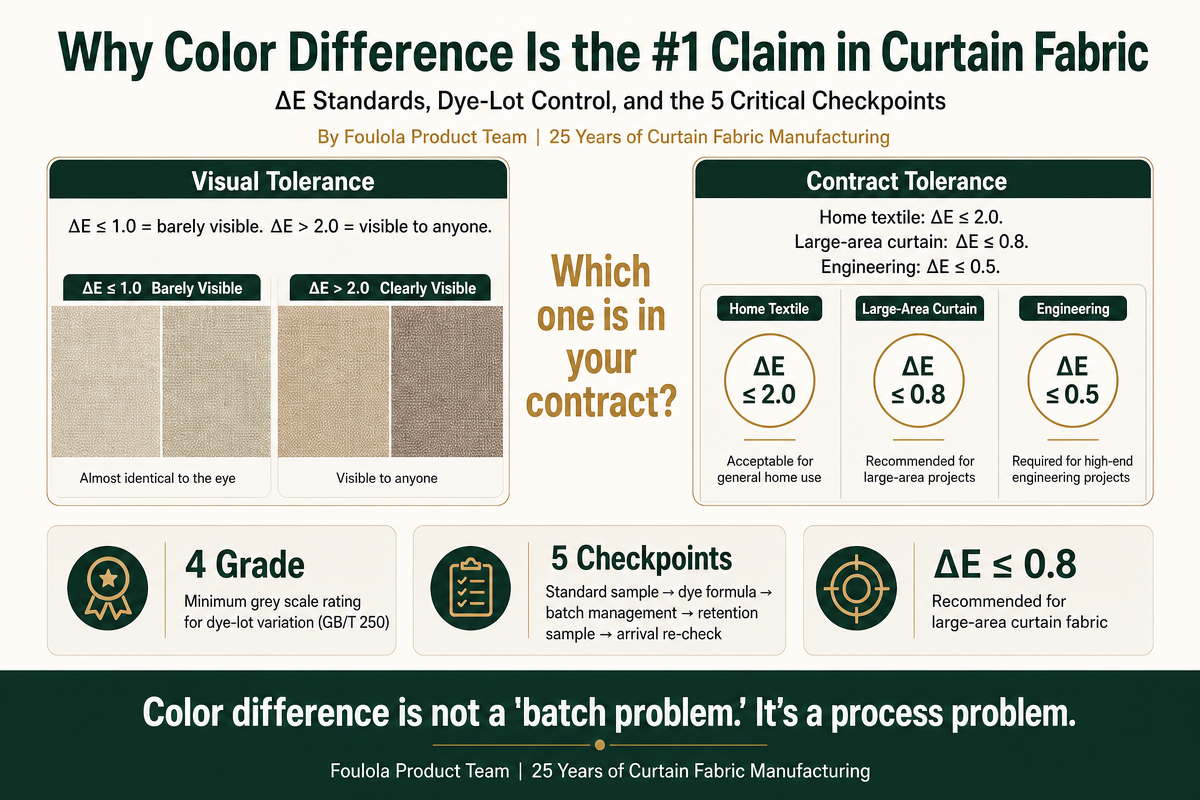
If you only remember one thing: a ΔE of 0.5 looks identical to a ΔE of 2.0 on a spec sheet—but only one of them will survive natural light in a hotel room. The article below gives you the ΔE standards, the five dye-lot control checkpoints, and the evidence chain you need before you sign.
1. Why Does a “Slight” Color Difference Become a Full-Batch Return?
A hotel project manager opens a container of curtain fabric. She unrolls the first panel. The color looks close enough to the approved sample—maybe a touch warmer, but nothing alarming. She unrolls a second panel from a different roll. Now the first panel looks slightly green against it.
Under factory lighting, the difference was invisible. Under the window’s natural light, it is obvious. Every guest will see it. Every photograph will capture it. The entire batch cannot be installed together.
This is the most common scenario in curtain fabric procurement. Color difference and color fastness remain the quality dispute categories with the highest claim rates in cross-border sourcing of soft furnishing textiles. The reason is practical: fabric is a large-area installed product. When curtains in the same room come from different production batches, even a slight deviation is amplified by natural light into a difference the human eye detects immediately. End users tolerate color inconsistency far less than they tolerate issues with dimensions or handfeel.
For fabric wholesalers and curtain shops, one batch color claim can trigger a chain reaction: full-batch returns, rework, schedule delays, and reputational damage. For hotel buyers, the cost is not just the fabric. It is the installation crew, the delayed opening, and the photographs that cannot be retaken.
The problem is that “color difference” is not a single defect. It has a measurable definition, a controllable process, and a verifiable evidence chain. Most claims happen because one of these three is missing. This article supplies all three.
2. What Does “ΔE ≤ 0.8” Actually Mean? And Why Is Your Contract Probably Too Loose?
Before you can control color, you need a number that both you and your supplier agree on.
The industry measures color difference using CIELAB ΔE, read by spectrophotometers such as Datacolor or X-Rite under a standard illuminant (usually D65). The smaller the ΔE, the closer the match. But “qualified” depends entirely on the product and the project.
Here is how the tolerance ladder actually looks:
| Application / Standard | ΔE Tolerance | What It Means in Practice |
|---|---|---|
| Engineering project, multiple curtains in one space | ΔE ≤ 0.5 | The safest threshold for visual consistency under natural light |
| Large-area home textile (curtain recommended) | ΔE ≤ 0.8 | Industry-recommended for curtain fabric where the surface is fully visible |
| General home textile / curtain (GB/T 22796 reference) | ΔE ≤ 2.0 | The baseline “acceptable” for bedding and curtains, but too loose for hotel projects |
| Domestic general orders / curtain / sofa (industry reference) | ΔE ≤ 1.0 – 1.5 | Common internal control range for standard orders |
| Visual perception threshold | ΔE ≤ 1.0 | The human eye generally cannot detect a difference |
| Clearly visible difference | ΔE > 2.0 | Most buyers will reject or request rework |
The critical gap is between the standard minimum and the project reality. GB/T 22796-2021 sets ΔE ≤ 2.0 as acceptable for home textiles including curtains. But for a hotel guest room with floor-to-ceiling curtains filling an entire wall, ΔE = 2.0 is a color difference every guest can see. This is why high-end projects and engineering procurement move the target to ΔE ≤ 0.8 or even ≤ 0.5.
What this means for your contract: Do not write “color difference meets national standards” and stop there. Write the specific ΔE value, the specific illuminant (D65), and the specific measurement geometry. If you are a wholesaler supplying curtain shops, ΔE ≤ 1.0–1.5 may be commercially reasonable. If you are supplying a hotel, write ΔE ≤ 0.8, and for multiple panels in one room, write ΔE ≤ 0.5.
3. What Causes Dye-Lot Variation—and Why Can’t Your Supplier “Just Match It”?
“Dye-lot variation” specifically refers to the color difference between different dye vats producing the same color. It is the single largest source of batch color deviation, and it is not a matter of the supplier “trying harder.”
The causes are physical and systemic. Dye concentration shifts slightly as a vat is reused. Temperature control during dyeing—often requiring precision around 60°C—affects dye uptake; too low, and the fiber absorbs poorly; too high, and the dye hydrolyzes. Dyeing time differences change penetration depth. Electrolyte and alkali dosage, bath ratio (fabric-to-water ratio), and residual dye liquor from the previous batch all introduce small deviations that accumulate into a visible color shift.
In inspection, dye-lot variation is commonly required to reach at least Grade 4 on the grey scale (GB/T 250) between two batches. But grey scale grading is a visual assessment under controlled conditions. It is a floor, not a guarantee of color consistency under the variable natural light of a real room.
This is why dye-lot control cannot be a single “check” at the end. It requires a chain of controls, from the standard sample to the arrival re-check. The next section maps that chain.
4. What Are the 5 Control Points That Actually Prevent Batch Color Claims?
A legitimate dye-lot control process has five interlocking checkpoints. If any one is missing, the chain breaks, and the claim risk transfers to you.
Checkpoint 1: Standard Sample Confirmation
Before bulk production, both parties must agree on a physical standard sample—not a digital image, not a verbal description. The sample should be signed, dated, and sealed by both sides. For curtain fabric, the standard sample should specify the light source under which color will be judged (D65 is standard) and the ΔE tolerance for batch-to-batch variation.
Buyer action: Keep one sealed copy of the standard sample in your own files. Do not rely solely on the supplier’s retained sample.
Checkpoint 2: Dye Formula and Process Locking
Once the standard sample is approved, the dye formula, auxiliary dosage, dyeing curve (temperature/time), and finishing parameters should be locked and documented. For repeat orders, the original process file should be retrievable and applied without ad-hoc adjustments. If the supplier changes dye suppliers or shifts the dyeing machine, a new lab-dip and pre-production sample should be approved before bulk production.
Buyer action: Ask whether a written process record exists for the approved standard. If the answer is vague, the risk is yours.
Checkpoint 3: Batch Management and Split-Vat Retention
For orders that require multiple dye vats, the supplier should implement split-vat retention sampling: each dye vat retains a physical swatch for batch-to-batch comparison. If the order is large enough to avoid split-vat production, specify “single-vat production” in the contract. If split-vat is unavoidable, agree in advance on the acceptable ΔE range between vats and the process for approving head-cylinder samples before the remaining vats proceed.
Buyer action: For high-visibility projects, require single-vat production. For repeat orders, specify that the same dye vat and process route be used where possible.
Checkpoint 4: In-Process Retention and Head-Cylinder Approval
Before bulk dyeing, the head-cylinder sample should be submitted to the buyer for approval against the standard sample. Once approved, the head-cylinder swatch becomes the reference for the remaining production. During production, the factory should retain swatches from each vat and record the measured ΔE against the standard.
Buyer action: Request the head-cylinder ΔE report before authorizing the balance of the order. If the head-cylinder is already at ΔE 1.2, the remaining vats will not improve.
Checkpoint 5: Arrival Re-Check and Retention Sample
When the fabric arrives, the buyer should conduct a visual comparison against the sealed standard sample under a standard light source (D65 light box, not office lighting). If a spectrophotometer is available, measure ΔE at multiple points across the roll and across different rolls. Retain a retention sample from the arriving batch—at least A4 size, labeled with batch number, date, and measured ΔE—for future reference.
Buyer action: Do not skip this step because “the supplier sent a test report.” The test report describes the sample the supplier selected, not the roll you received.
5. If a Claim Happens, What Evidence Do You Actually Need?
Color claims are won or lost on documentation, not on argument. The evidence chain has four links.
Link 1: The sealed standard sample. Without a signed, dated standard sample, there is no objective baseline for “what the color should have been.” A supplier can argue that the delivered color is within the general tolerance for the color name. Your sealed sample is the reference that makes the argument specific.
Link 2: The contract tolerance and test method. The contract should specify the ΔE value, the illuminant (D65), the measurement geometry, and the number of measurement points. It should also specify the inspection window (e.g., 7 days from arrival) and the procedure for notifying a claim.
Link 3: The retention sample and measurement record. Your arrival retention sample, labeled and stored, is the physical evidence of what was delivered. If the claim proceeds to third-party testing, this sample is what gets tested. A written record of the measured ΔE values (even from a handheld spectrophotometer) strengthens the claim.
Link 4: Third-party test report. If the dispute cannot be resolved internally, a third-party testing body with CMA/CNAS accreditation can measure the ΔE between the delivered sample and the sealed standard under controlled conditions. This report is the evidence that carries weight in arbitration or litigation.
Practical note: The absence of any one of these four links weakens the claim substantially. In legal disputes over fabric color, courts have found that without a properly retained and agreed-upon standard, the buyer cannot prove that the delivered goods deviate from the contract.
6. A 25-Year Fabric Factory’s Observation on Color Consistency
Over 25 years in production, Foulola has observed that color claims are rarely caused by single, catastrophic dyeing errors. They are the cumulative result of minor process failures: an unsealed standard sample, unretained dye-lot swatches, or head-cylinder approvals granted without measured ΔE data.
In the product lines that supply hotel and project clients, color control is treated as a process, not an inspection step. Standard samples are sealed and stored. Dye lots are retained. Head-cylinder ΔE is measured against the standard before bulk production proceeds. For repeat orders, the original process file is retrieved, not recreated.
This is not a marketing claim about “better color.” It is a description of a control chain that any buyer can verify. If you are sourcing curtain fabric for a project where color consistency matters, ask your supplier a specific question: “What is the ΔE of the head-cylinder against the sealed standard, and can I see the retention sample from the last batch?” A supplier who can answer with a number and a sample is operating a process. A supplier who answers with “don’t worry, we’re very careful” is asking you to carry the risk.
7. Conclusion: Color Consistency Is a Contract, Not a Promise
Color difference claims are not inevitable. They are the predictable result of a process where one or more control points were skipped.
The ΔE number in your contract matters, but only if it is paired with a sealed standard sample, a specified light source, and a retention sample from the delivered batch. The five checkpoints—standard sample, formula locking, batch management, head-cylinder approval, and arrival re-check—form a chain. Break one link, and the claim risk shifts to you.
For fabric wholesalers and curtain shops, building this chain into your supplier qualification process protects your margin and your reputation. For designers and hotel buyers, writing it into the procurement specification is the difference between a color that holds together under natural light and a batch that gets rejected on installation day.
Color is the first thing the eye sees. Make it the first thing your contract controls.
This article is part of Foulola's B2B Educational Series. For technical specifications, retention samples, or color measurement reports, please visit www.foulola.com or contact your sales representative.
References
National Standards (China):
-
GB/T 250-2008, Textiles – Tests for colour fastness – Grey scale for assessing change in colour.
-
GB/T 22796-2021, Bedding (Current consolidated standard covering home textiles including curtains).
-
GB/T 8424.3-2001, Textiles – Tests for colour fastness – Calculation of colour differences.
Industry References:
-
CIELAB ΔE measurement under D65 standard illuminant, using Datacolor or X-Rite spectrophotometers.
-
Dye-lot variation control practices: split-vat retention sampling, head-cylinder approval, and grey scale Grade 4 minimum.
Table of Contents
- Why Is Color Difference the #1 Claim in Curtain Fabric? A Guide to ΔE Standards and Dye-Lot Control
- 1. Why Does a “Slight” Color Difference Become a Full-Batch Return?
- 2. What Does “ΔE ≤ 0.8” Actually Mean? And Why Is Your Contract Probably Too Loose?
- 3. What Causes Dye-Lot Variation—and Why Can’t Your Supplier “Just Match It”?
- 4. What Are the 5 Control Points That Actually Prevent Batch Color Claims?
- 5. If a Claim Happens, What Evidence Do You Actually Need?
- 6. A 25-Year Fabric Factory’s Observation on Color Consistency
- 7. Conclusion: Color Consistency Is a Contract, Not a Promise
- References

