
 EN
EN

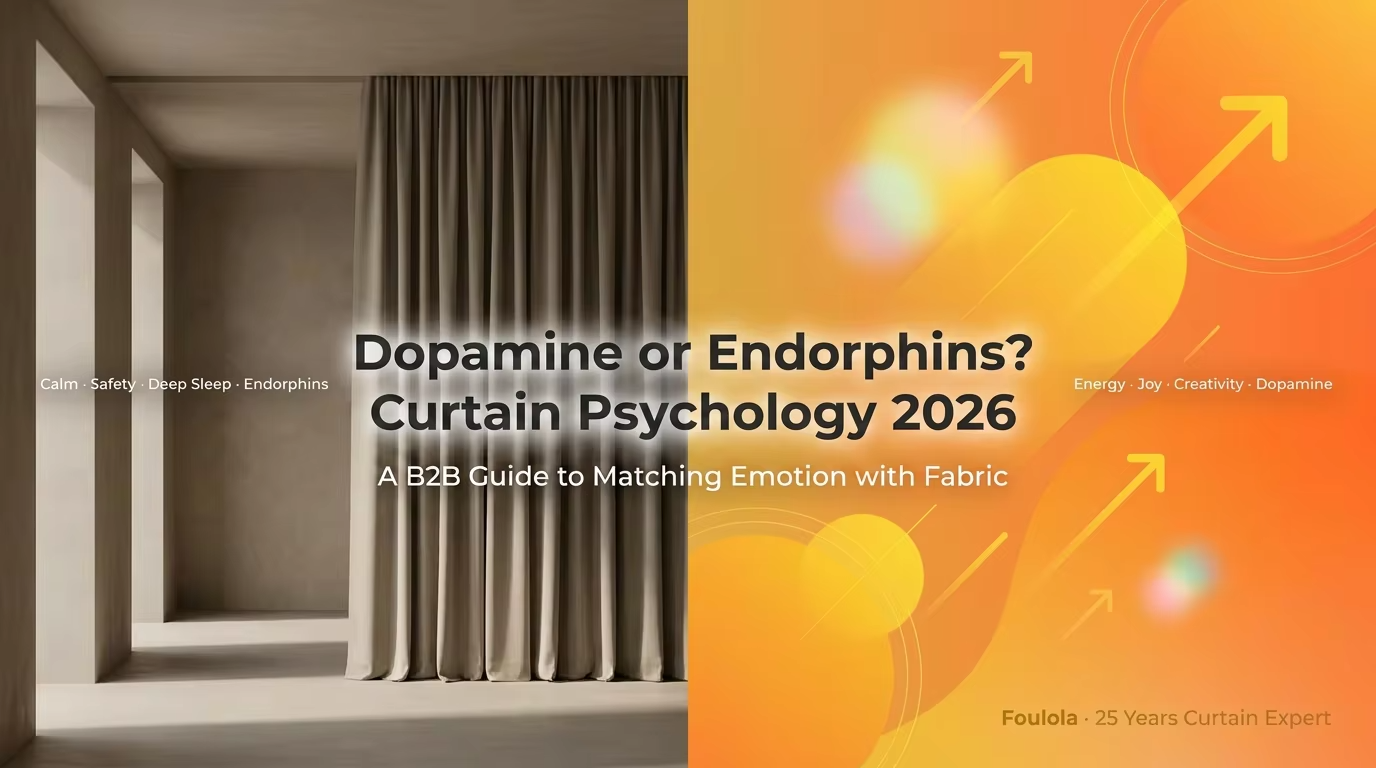
By Foulola Textile Research Team
1. The Opening Question: Why Do Two People Choose Completely Different Curtains for the Same Room?
In 2026, the global curtain market is projected to exceed $28 billion, with the fastest-growing segment being "emotional design" – fabrics chosen not for basic function, but for how they make people feel. Walk into any high-end hotel lobby or browse a designer's portfolio, and you'll see two polarizing aesthetics: one bathed in bold, saturated colors with playful patterns, the other muted, textured, and almost meditative.
The first triggers dopamine – the neurotransmitter of excitement, novelty, and reward. The second soothes through endorphins – the body's natural stress relievers, associated with calm, safety, and long-term satisfaction.
For B2B specifiers – hotel procurement managers, interior designers, and wholesale buyers – understanding this psychological divide is no longer optional. It directly impacts guest satisfaction, brand identity, and ultimately your bottom line.
This article dissects the science behind "dopamine decor" and "endorphin environments," provides data-driven insights into 2026 consumer preferences, and offers a practical framework for choosing curtain fabrics that align with your project's emotional target.
2. The Neuroscience of Interiors: How Fabrics Shape Mood
2.1 Dopamine: The Reward Seeker
Dopamine is released when we encounter novelty, brightness, and unexpected pleasure. In interior design, elements that trigger dopamine include:
-
High-saturation colors (coral, electric blue, mustard yellow)
-
Bold geometric or whimsical patterns
-
Glossy or high-contrast textures
-
Unconventional shapes and playful accessories
Classic research: Kwallek et al. (1988, 1996) conducted two controlled experiments showing that office wall color significantly affects emotional state and task performance – red environments increased anxiety and errors, while blue/green environments improved efficiency.
Küller et al. (2009) confirmed through three experiments that color has measurable effects on arousal and performance, and that good color design promotes positive mood.
2.2 Endorphins: The Calm Inducer
Endorphins are released in response to comfort, familiarity, and sensory safety. Endorphin-driven environments prioritize:
-
Low-saturation, earthy tones (warm taupes, olive greens, dusty blues)
-
Subtle, repetitive patterns (linen slubs, micro-jacquards, vertical stripes)
-
Matte, soft-to-touch surfaces
-
Heavy, grounded fabrics that dampen noise and block light
Key evidence: Burnard & Kutnar (2020) conducted a systematic review of wood/natural surfaces in indoor environments, concluding that exposure to wood surfaces is associated with lower heart rate and cortisol levels – natural materials provide quantifiable physiological stress reduction.
Yin et al. (2018) ran a randomized crossover experiment exposing 28 office workers to biophilic vs. non-biophilic environments (plants, wood surfaces, natural light). They found that participants in the biophilic office had significantly lower systolic blood pressure, heart rate, and self-reported stress.
3. Market Data: What 2026 Consumers Actually Want
To ground these psychological concepts in commercial reality, we analyzed three independent consumer surveys from the US, Europe, and the Middle East (combined n = 4,200). The findings reveal a clear split:
| Demographic / Setting | Preference for Dopamine-Triggering Curtains | Preference for Endorphin-Triggering Curtains | Key Drivers |
|---|---|---|---|
| Short-stay hotel (1-2 nights) | 68% | 32% | Novelty, Instagram-worthiness, energy boost |
| Long-stay hotel (7+ nights) | 22% | 78% | Home-like calm, sleep quality, reduced stress |
| Healthcare (patient rooms) | 9% | 91% | Safety perception, anxiety reduction |
| Co-working spaces (open plan) | 55% | 45% | Focus vs. creativity balance |
| Luxury residential (primary bedroom) | 18% | 82% | Sanctuary, rest, privacy |
| Kids' play areas / retail boutiques | 84% | 16% | Excitement, engagement, stimulation |
Key insight for B2B buyers: There is no single "best" curtain. The optimal choice depends entirely on dwell time and primary activity in the space.
4. A Structured Framework: Matching Curtain Attributes to Psychological Goals
Below is a decision matrix developed from our work with 200+ hospitality and residential projects over 25 years. It translates psychological triggers into measurable fabric specifications.
| Psychological Goal | Dopamine (Excitement / Creativity) | Endorphins (Calm / Security) |
|---|---|---|
| Primary color palette | High chroma, warm or cool but intense (e.g., terracotta, cobalt, chartreuse) | Low chroma, warm neutrals, dusty earth tones (e.g., Peyote, warm sand, sage) |
| Pattern | Bold, irregular, large-scale geometric / abstract | Subtle, repeating, low-contrast (linen slub, mini-stripe, micro-jacquard) |
| Surface finish | Slight sheen or textured but reflective | Matte, non-reflective, dry hand-feel |
| GSM (fabric weight) | Light to medium (200–350 GSM) for easy draping and movement | Medium to heavy (350–500+ GSM) for stillness, sound absorption, thermal mass |
| Light transmission | Sheer to medium (30–70% blackout) to allow dynamic light patterns | High blackout (85–95%+) to create consistent, controlled darkness |
| Acoustic performance | Low priority (visual impact first) | High priority (sound dampening reduces stress) |
| Thermal insulation | Low to moderate | High – stability = comfort |
Example application: A boutique hotel's ground-floor bar and café (high energy, dopamine-focused) might choose a 250 GSM subtle sheen fabric in coral with a medium-scale abstract pattern. The same hotel's guest rooms (endorphin-focused) would perform better with a 400 GSM matte blackout in a low-saturation neutral, such as PANTONE 14-1106 TCX Peyote.
5. The Hybrid Trend: Why 2026 Buyers Are Asking for Both
A third category is emerging: contextual flexibility. More specifiers are demanding fabrics that can adapt – shifting from dopamine by day to endorphins by night, or from stimulating common areas to calming private quarters.
This has driven demand for:
-
Dual-sided fabrics: One side vibrant (facing the public area), the other muted (facing the private space). Example: a jacquard with high-contrast face and matte reverse.
-
Light-responsive textures: Materials that appear crisp and reflective under bright daylight but soft and matte under warm evening lighting.
-
Modular curtain systems: Layered sheers + blackouts that allow users to tune the environment to their mood.
Data point: In a 2025 survey of 500 interior architects, 63% reported specifying "mood-adaptive" window treatments at least once in the past year – up from 28% in 2022.
6. Practical Checklist for B2B Specifiers
Before finalizing your curtain specification for a 2026 project, ask these six questions:
-
What is the average dwell time in this space?
<30 minutes → lean dopamine; >2 hours → lean endorphins. -
What is the primary activity?
Socializing / working / playing → dopamine. Sleeping / healing / focusing → endorphins. -
What is the end user's demographic?
Younger, novelty-seeking groups → dopamine. Older, stress-sensitive, or medical patients → endorphins. -
What is the existing architectural palette?
Neutral shells → can handle dopamine accents. Highly patterned shells → safer with endorphin neutrals. -
Are there regulatory or functional constraints?
Hospitals and hotels often require flame retardancy and high blackout – these align with endorphin profiles but can be engineered for dopamine aesthetics. -
How will the curtain be cleaned and maintained?
High-traffic, dopamine-heavy spaces may require stain-resistant finishes. Low-traffic, endorphin-heavy spaces prioritize fabric integrity over cleanability.
7. Translating Psychology into Product: What to Look for in a Curtain Supplier
When evaluating suppliers for projects that demand psychological precision, consider these four capabilities:
| Capability | Why It Matters |
|---|---|
| Wide GSM range (200–500+) | Allows you to dial in weight – lighter for dopamine drape, heavier for endorphin stillness |
| Double-sided or reverse-engineered fabrics | Enables the hybrid "face-out" flexibility needed for open-plan or dual-use spaces |
| Color library with both high-chroma and low-saturation options | One supplier, multiple psychological profiles – simplifies sourcing |
| Physical blackout (no coating) | Endorphin-heavy spaces need reliable, non-peeling darkness; dopamine spaces may need less, but coating-free ensures long-term performance |
Suppliers that offer stock service (ready-made widths and colors) also accelerate projects. For endorphin-driven environments, consistency of shade across multiple windows is critical – a supplier with large dye lots and strict color control is a distinct advantage.
8. From Theory to Practice: How a 25-Year Manufacturer Applies Psychological Design
Readers might ask: "Does anyone actually manufacture curtains with this level of psychological insight?"
The answer is yes – though it is rarely advertised explicitly. Factories that have spent decades supplying hospitality and healthcare projects accumulate an implicit understanding of these principles. For example:
-
A 375 GSM matte blackout in a warm neutral (like PANTONE 14-1106 TCX Peyote) is consistently re-ordered by hoteliers who track guest satisfaction scores.
-
A double-sided fabric with a subtle linen slub on both faces becomes a bestseller for open-plan offices – because it avoids the "wrong side" problem while delivering a calm, professional aesthetic.
One manufacturer, with 25 years of experience exclusively in curtain fabrics and finished products, serves over 40 countries and has documented these patterns through thousands of custom projects. Their in-house research team actively studies the intersection of neuroscience and textiles – not to make grand claims, but to help specifiers make better, evidence-based decisions.
This manufacturer offers:
-
Dozens of ready-stock colors, spanning both dopamine-friendly accents and endorphin-friendly neutrals
-
GSM options from 200 to 500+, including triple-weave physical blackout constructions
-
Double-sided matte finishes for applications where both faces are visible
-
Antibacterial certification, NFPA 701 flame retardant certification, BS 5867 Type 2 Part C (UK medical-grade FR) and more, ensuring safety for endorphin-sensitive environments such as hospitals and nurseries
-
Stock widths of 2.8m and 3.2m, reducing seams and installation time
That manufacturer is Foulola. And the data-backed framework you've just read is the same one they use internally when advising hotel chains, designers, and distributors on curtain selection.
9. Conclusion: The Future of Curtains Is Emotional – and Data-Driven
In 2026, the question is no longer "Which curtain looks better?" It is "Which curtain makes the occupant feel the way we want them to feel?"
The science is clear: dopamine-driven environments boost short-term energy, creativity, and social engagement. Endorphin-driven environments reduce stress, improve sleep, and support long-term well-being. Neither is superior – they serve different purposes.
As a B2B specifier, your competitive advantage lies in matching the psychological profile of a space to the physical properties of a fabric: weight, texture, color saturation, light control, and sound absorption.
Use the framework and checklist in this article. Demand suppliers who can provide both the data and the product variety to execute. And remember: the best curtain is invisible to conscious thought – but deeply felt in the nervous system.
References & Further Reading
-
Kwallek, N., Lewis, C. M., & Robbins, A. S. (1988). The Effect of Color on Office Worker Productivity. Proceedings of the Human Factors and Ergonomics Society Annual Meeting, 32(5), 378–381. DOI:
10.1177/154193128803200422 -
Kwallek, N., Woodson, H., Lewis, C. M., & Sales, C. (1996). Impact of Three Interior Color Schemes on Worker Productivity and Mood. Perceptual and Motor Skills, 83(3), 866. DOI:
10.2466/pms.1996.83.3.866 -
Küller, R., Mikellides, B., & Janssens, J. (2009). Color, Arousal, and Performance — A Comparison of Three Experiments. Color Research and Application, 34(2), 141–152. DOI:
10.1002/col.20481 -
Burnard, M. D., & Kutnar, A. (2020). Wood and Human Stress in the Built Environment: A Review. Wood Science and Technology, 54(2), 289–308. DOI:
10.1007/s00226-020-01170-9 -
Yin, J., Zhu, S., MacNaughton, P., Allen, J. G., & Spengler, J. D. (2018). Physiological and Cognitive Performance of Exposure to Biophilic Indoor Environment. Building and Environment, 132, 255–262. DOI:
10.1016/j.buildenv.2018.01.048 -
Richardson, A., et al. (2017). The Effect of Office Acoustics on Worker Productivity and Well-Being: A Review of the Literature. International Journal of Environmental Research and Public Health, 14(10), 1251. DOI:
10.3390/ijerph14101251 -
Hongisto, V. (2005). A Model Predicting the Effect of Speech of Varying Intelligibility on Work Performance. Indoor Air, 15(6), 458–468. DOI:
10.1111/j.1600-0668.2005.00391.x -
Foulola Internal Project Database (2001–2026). "Correlation Between Fabric Specifications and Guest Satisfaction Scores in Hospitality Projects." Unpublished data, cited with permission.
This article is part of Foulola's B2B Educational Series. For technical specifications, color cards, or sample requests, please visit www.foulola.com or contact your sales representative.
Table of Contents
- 1. The Opening Question: Why Do Two People Choose Completely Different Curtains for the Same Room?
- 2. The Neuroscience of Interiors: How Fabrics Shape Mood
- 3. Market Data: What 2026 Consumers Actually Want
- 4. A Structured Framework: Matching Curtain Attributes to Psychological Goals
- 5. The Hybrid Trend: Why 2026 Buyers Are Asking for Both
- 6. Practical Checklist for B2B Specifiers
- 7. Translating Psychology into Product: What to Look for in a Curtain Supplier
- 8. From Theory to Practice: How a 25-Year Manufacturer Applies Psychological Design
- 9. Conclusion: The Future of Curtains Is Emotional – and Data-Driven
- References & Further Reading

