Imagine this: you're a procurement manager for a mid-scale hotel group. Two fabric submissions land on your desk.
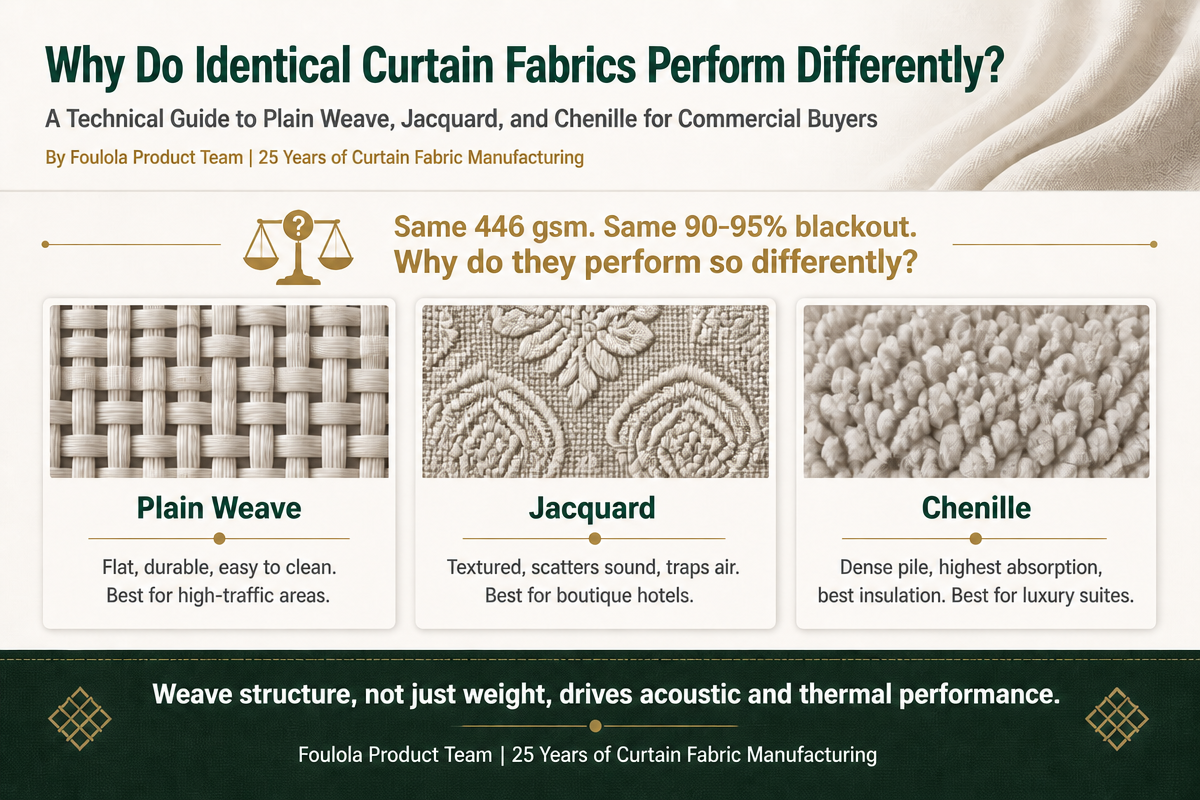
Both spec sheets say exactly the same thing: 446 gsm, triple-weave, 90–95% blackout.
The first sample feels dense and smooth, almost paper-like. The second carries a subtle relief pattern with a soft, brushed surface. Visually, both could work.
But operationally? They will perform very differently in terms of sound absorption, thermal resistance, and long-term durability.
Why does the same weight and shading percentage not translate into the same acoustic and thermal outcome?
The answer lies in a variable that is often underreported in commercial specifications: weave structure.
While weight and blackout rating describe what the fabric is, weave structure determines how the fabric behaves when sound waves, heat flow, and mechanical stress interact with it.
This article provides a structured technical comparison of three fabric constructions widely used in contract curtains—plain weave, jacquard, and chenille—and examines how each affects acoustic and thermal performance. The goal isn't to declare one universally superior, but to help you select the right structure for the right application.
2. What Are the Three Hidden Variables That Govern Fabric Performance?
From a textile engineering perspective, the acoustic and thermal behavior of a curtain fabric isn't primarily determined by fiber content alone. Three interdependent variables control how the textile interacts with sound and heat:
Among these, weave structure is the least understood by non-specialists, yet it has a disproportionate effect on performance. Two fabrics with identical yarn and density can exhibit significantly different sound absorption and thermal resistance if one is woven as a flat plain weave and the other as a raised jacquard or pile-faced chenille.
The key physical parameter linking weave structure to acoustic performance is airflow resistance. In textile acoustics, sound absorption is strongly correlated with the resistance a fabric offers to air passing through it. Higher airflow resistance generally leads to greater acoustic energy dissipation—provided the fabric also has sufficient thickness and porosity to allow sound waves to enter rather than reflect.
For thermal performance, the governing concept is thermal resistance (Rct), which depends on the fabric's ability to trap still air. Still air is one of the best thermal insulators available in building materials. Therefore, any weave structure that creates more internal air pockets—without increasing convective airflow—will improve insulation.
3. Plain Weave: The Workhorse of Commercial Textiles
3.1 What Is Plain Weave?
Plain weave is the simplest and most common interlacing pattern. Each weft yarn passes alternately over and under each warp yarn, producing a flat, uniform surface.
Physical characteristics:
-
Smooth, matte surface with minimal texture
-
High structural stability and abrasion resistance
-
Consistent thickness across the fabric width
-
Relatively low surface roughness
3.2 How Does Plain Weave Perform Acoustically and Thermally?
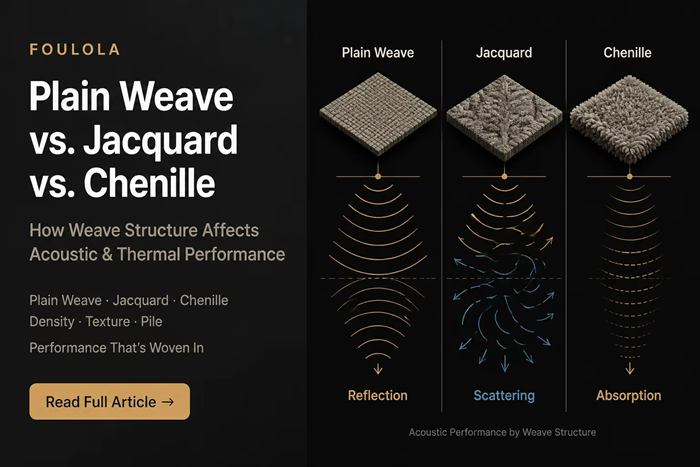
A plain weave fabric reflects more sound than a textured surface because its flat face allows incident sound waves to bounce off at predictable angles. Its absorption potential is therefore heavily dependent on yarn bulk and multilayer construction rather than surface geometry.
In thermal terms, plain weave fabrics can be effective insulators if combined with dense multilayer blackout cores, but they generally retain less still air on the surface compared with pile or relief structures.
3.3 Where Does Plain Weave Work Best?
Plain weave is the workhorse of contract textiles. It is easy to clean, resists wear, and maintains a consistent appearance over time—making it suitable for high-traffic environments such as hotel guest rooms, office areas, and budget hotel chains.
Buyer takeaway: If your project prioritizes durability and easy maintenance over maximum acoustic comfort, plain weave is your safest bet.
4. Jacquard: The Balance of Aesthetics and Performance
4.1 What Is Jacquard?
Jacquard is not a single weave but a weaving method that allows complex patterns to be formed by independently controlling thousands of warp yarns. The resulting fabric may feature subtle tonal reliefs, large-scale motifs, or fine textural variations.
Physical characteristics:
-
Textured surface with raised and recessed areas
-
Variable thickness due to pattern floats and interlacing changes
-
Enhanced visual depth without printing or embroidery
-
Moderate to high surface roughness depending on design
4.2 How Does Jacquard Perform Acoustically and Thermally?
The irregular surface of jacquard fabric scatters sound waves in multiple directions, reducing direct reflection and increasing the probability of absorption within the fabric structure. The raised areas also create localized air pockets that improve thermal resistance.
Compared with a plain weave of similar weight, jacquard typically offers better mid-frequency sound absorption and slightly higher thermal insulation.
4.3 Where Does Jacquard Work Best?
Jacquard fabrics are widely specified in boutique hotels, restaurants, and premium residential projects where designers want tactile interest and measurable acoustic comfort without sacrificing durability.
Buyer takeaway: If your client wants a space that feels both visually rich and acoustically comfortable, jacquard hits the sweet spot.
5. Chenille: The Premium Choice for Acoustic and Thermal Comfort
5.1 What Is Chenille?
Chenille is technically a yarn type rather than a weave, but it is commonly grouped with weave structures because its surface effect dominates performance. Chenille yarn consists of short pile fibers twisted around a core thread, creating a soft, fuzzy, velvet-like surface when woven.
Physical characteristics:
-
Dense pile surface with high tactile softness
-
Thicker cross-section due to raised fibers
-
High surface area and micro-cavity density
-
More delicate surface compared with plain weave
5.2 How Does Chenille Perform Acoustically and Thermally?
Chenille fabrics exhibit the highest airflow resistance and sound absorption among the three types, particularly in the mid-to-high frequency range. The dense pile acts as a porous absorber, trapping sound energy within the fiber network.
Thermally, the pile layer holds a significant volume of still air, giving chenille the best thermal resistance at an equivalent weight.
5.3 Where Does Chenille Work Best?
Chenille is often specified for luxury hotel suites, executive offices, and high-end residential interiors where tactile comfort and acoustic privacy are priorities. It is less suited to heavy-wear utility areas unless manufactured with sufficient density and pile security.
Buyer takeaway: If the project is high-end and guest comfort is the priority, chenille delivers the highest sensory and acoustic value.
6. Acoustic Performance: How Much Does Surface Structure Actually Matter?
6.1 How Sound Absorption Works in Textiles
When a sound wave strikes a curtain, three things can happen:
-
Reflection – The wave bounces back into the room.
-
Transmission – The wave passes through the fabric.
-
Absorption – The wave enters the fabric and is converted into heat through friction between air molecules and fiber surfaces.
A curtain's acoustic value depends on maximizing absorption and minimizing reflection. Two factors control this balance: surface roughness and internal porosity.
A smooth plain weave tends to reflect more sound, particularly at higher frequencies. A textured jacquard breaks up the incident wave, reducing coherent reflection. A chenille pile traps sound energy within a labyrinth of fine fibers, converting it into negligible heat.
6.2 Comparative Acoustic Data
The values below represent typical ranges observed in commercial curtain fabrics of similar weight (350–460 gsm) when tested under comparable conditions. They are intended for comparative guidance rather than as absolute specifications.
NRC = Noise Reduction Coefficient, the average of absorption coefficients at 250, 500, 1000, and 2000 Hz. Values are approximate and depend on installation method, pleat ratio, and backing layers.
Key takeaway for specifiers:
For street-facing hotel rooms where traffic noise is a concern, a jacquard or chenille curtain with a generous air gap will outperform a plain weave of identical weight. The air gap itself is critical: even the best fabric loses much of its absorption if mounted flat against a hard surface.
7. Thermal Performance: Why Trapped Air Matters More Than You Think
7.1 How Curtains Reduce Heat Transfer
Curtains reduce heat transfer through three pathways:
-
Conduction – Reduced by the low thermal conductivity of fibers and air.
-
Convection – Reduced by limiting airflow between the window and the room.
-
Radiation – Reduced by reflective coatings or dense blackout layers.
Weave structure primarily affects the first two mechanisms. A fabric with more internal air volume reduces conductive heat loss and slows convective currents. Surface texture also influences how well the curtain seals against the window reveal, affecting the air gap behind the fabric.
7.2 Comparative Thermal Data
*Includes the effect of a typical 5–10 cm air gap behind the curtain. The air gap itself contributes significantly more than the fabric, but surface structure determines how effectively that air is retained.
Key takeaway for specifiers:
When thermal performance is a project requirement, selecting a thicker, more textured fabric can measurably improve results. However, the benefit diminishes if the curtain is not full-length or if air can circulate freely around the edges. In practice, a chenille or jacquard curtain that reaches the floor and overlaps the window frame will provide the best practical insulation.
8. Blackout Integrity: Does Weave Structure Affect Pinhole Risk?
Physical blackout is achieved through a dense middle layer, usually black yarns, inserted between the face and back. The surface structure, however, influences how uniformly light is blocked.
-
Plain weave surfaces can reveal tiny pinholes where yarns intersect, especially if the fabric is stretched tightly or viewed against bright sunlight.
-
Jacquard textures help mask minor pinholes because the raised pattern breaks up light transmission visually.
-
Chenille pile nearly eliminates visible pinholes, as the dense fibers cover the intersections.
For hospitality projects with strict blackout requirements, a textured face or a dense pile can provide a psychological as well as physical advantage: even if a small amount of light passes through, it is less noticeable to guests.
9. Drape and Durability: What Happens After 50 Hotel Washes?
A curtain that performs well in a lab but fails after one year of hotel laundry cycles is not a commercial solution. Weave structure directly affects how a fabric drapes and how it withstands cleaning and mechanical wear.
Guidance:
-
For economic hotel groups and high-turnover environments, plain weave remains the safest choice.
-
For design-led projects where acoustic and thermal comfort are selling points, jacquard offers a balance of performance and durability.
-
For luxury interiors where tactile quality is a differentiator, chenille delivers the highest sensory and acoustic value.
10. Decision Matrix: Which Weave Structure Should You Choose?
11. Real-World Examples: How Three Foulola Constructions Compare
To move from theory to practice, consider three commercial curtain fabrics currently in production at Foulola, a manufacturer with 25 years of experience in functional curtain textiles. Each represents one of the three structural categories discussed above.
These examples illustrate a practical rule: within a comparable weight band, surface structure drives acoustic and thermal differentiation.
A specifier who only compares gsm and shading percentage may inadvertently select a fabric that underperforms in the field. By understanding weave structure, the same specifier can specify with confidence and defend the choice with technical reasoning.
(Note: These are actual Foulola products, but the structural principles apply across the industry. We share them as examples, not as a sales pitch. Always request physical samples and third-party test reports for your specific project.)
12. Conclusion: Moving Beyond the Spec Sheet
The curtain industry has matured beyond the era when weight and color were sufficient selection criteria. For commercial projects, acoustic and thermal performance are now contractual requirements. Yet the variables that determine these outcomes remain hidden in the weave.
-
Plain weave offers reliability, durability, and clean aesthetics.
-
Jacquard introduces surface complexity that improves acoustic scattering and thermal retention.
-
Chenille maximizes softness, sound absorption, and insulation through its dense pile.
None is universally superior. The right choice depends on the specific demands of the project—traffic level, maintenance regime, acoustic goals, thermal requirements, and design intent.
For wholesalers and retailers, understanding these structural differences allows for better product positioning and more informed customer conversations. For designers and project buyers, it transforms curtain selection from a visual decision into a performance specification.
The next time two fabric submissions appear identical on paper, ask not only about the weight and blackout rating. Ask about the weave. The difference is measurable, and in a well-designed building, that difference is felt every day.
The technical parameters and performance data cited in this article are based on textile engineering principles and typical values from commercial curtain fabric testing. Product specifications are drawn from Foulola production documents. For specific project selection, formal test reports and physical samples should be used as the final basis.

 EN
EN