
 EN
EN

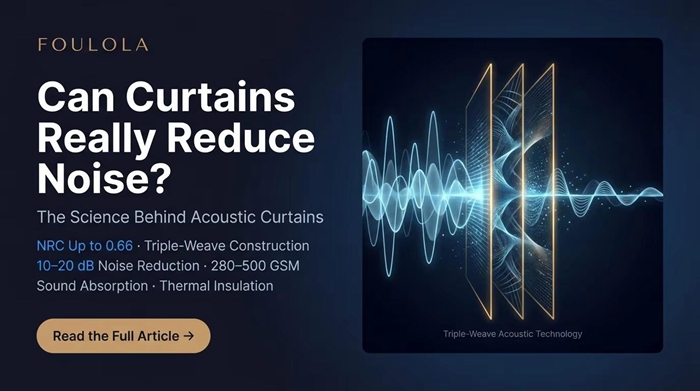
1. Introduction: A Question Asked Again and Again
"Can curtains really block noise?"
This question appears in nearly every discussion about indoor noise reduction. City dwellers type it repeatedly into search engines. Hotel procurement officers raise it in product selection meetings. Office managers ask it when facing noise complaints in open-plan workspaces.
The answer is not straightforward. It is neither a simple "yes" nor a simple "no" — it depends on how you define "soundproofing" and what kind of curtains you choose.
This article starts from acoustic principles, unpacks the real mechanisms behind curtain noise reduction, and uses data and logic to answer this seemingly simple yet deeply nuanced question.
2. A Rapidly Growing Market
Before diving into acoustic principles, it is worth examining the market's response. If curtain noise reduction were merely a marketing gimmick, it would not support a multi-billion-dollar industry.
The global soundproof curtains market was valued at approximately $2.34 billion to $3.53 billion in 2025, with different institutions reporting varying figures. According to The Business Research Company, the market is expected to grow from $2.34 billion in 2025 to $2.52 billion in 2026, reaching $3.43 billion by 2030. 360iResearch™ projects a more optimistic trajectory — $3.53 billion in 2025, growing to $9.22 billion by 2032 at a CAGR of 14.68%. OG Analysis reports the 2025 market at $2.9 billion, with projections of $5.5 billion by 2033.
Several real-world factors are driving this growth: worsening noise pollution due to urbanization, rising demand for quiet home environments following the shift to remote work, and increased emphasis on acoustic comfort in hotels and healthcare facilities. The rise of hybrid work has transformed "not being disturbed by street noise while working from home" from a luxury into a daily necessity.
The market is voting with real money. But the question remains: how do these curtains actually work?
3. What Is Sound? — The Starting Point
To understand how curtains reduce noise, we must first understand what sound is.
Sound is essentially vibration transmitted through air. When a sound source (such as a passing car, a conversation, or an air conditioner compressor) vibrates, it creates pressure fluctuations in the surrounding air — these are sound waves. These waves travel outward until they encounter an obstacle.
When a sound wave meets a surface, one of three things happens: reflection, absorption, or transmission.
-
Hard surfaces (glass, concrete, tiles) primarily reflect sound waves. This is why an empty room with no furniture sounds particularly "loud" — sound bounces back and forth between hard surfaces, creating echoes and reverberation.
-
Soft surfaces (carpet, foam, fabric) primarily absorb sound waves. As sound waves enter the pores of the material, air friction converts some acoustic energy into heat.
-
Dense materials (thick walls, multi-layer structures) can block sound waves, making transmission difficult.
The core mechanism of curtain noise reduction lies in combining both absorption and blocking principles through material selection and structural design.
4. Acoustic Principles of Soundproof Curtains
A typical soundproof curtain consists of multiple layers, each serving a distinct acoustic function:
| Layer | Material | Acoustic Function |
|---|---|---|
| Outer Layer (Decorative) | Fabric | Protects inner structure, guides sound waves into absorption layer |
| Middle Layer (Absorption) | Porous materials (fibers, felt) | Absorbs sound energy, reduces reflection and echo |
| Inner Layer (Barrier) | High-density materials | Adds mass, blocks sound wave transmission |
The porous absorption layer works on a simple principle: when sound waves enter the tiny pores within the material, air flow encounters friction resistance, converting part of the acoustic energy into heat. This explains why heavy, dense, multi-layer curtains perform better than lightweight ones — they provide more "friction opportunities" to dissipate sound energy.
The high-density barrier layer operates according to the mass law: the greater the mass of a material, the harder it is for sound waves to set it in vibration, and therefore less sound energy is transmitted through it.
5. Sound Absorption vs. Sound Insulation: Two Distinct Paths
This is the most critical step in understanding curtain noise reduction. Sound absorption and sound insulation are two different concepts — they address different problems and are measured by different standards.
| Dimension | Sound Absorption | Sound Insulation |
|---|---|---|
| Goal | Improve sound quality within a room | Prevent sound from entering or leaving a room |
| Problem Solved | Echo, reverberation, speech clarity | External noise intrusion, internal sound leakage |
| Working Principle | Converts sound energy into heat | Uses mass to block sound wave transmission |
| Measurement Metric | NRC (Noise Reduction Coefficient) | STC (Sound Transmission Class) |
| Typical Materials | Porous materials (fibers, foam, fabric) | High-density materials (drywall, mass-loaded vinyl) |
Sound absorption addresses "how good does the sound inside the room feel" — reducing echo and reverberation to make speech clearer and spaces quieter. Sound insulation addresses "outside sounds stay out, inside sounds stay in" — this requires airtight structures and sufficient mass.
Curtains perform well in sound absorption but serve only a supporting role in sound insulation.
The reason is simple: curtains cannot be airtight. Sound always finds its way around the curtain through gaps between the fabric and the wall, or between the track and the ceiling. True sound insulation requires sealed walls, acoustic windows, and sealed doors — curtains cannot replace these.
Thus, a more accurate description is: curtains are "noise-reducing" tools, not "soundproofing" tools. They can significantly improve a room's acoustic environment, but they cannot turn a room next to a highway into a recording studio.
6. How Is Curtain Acoustic Performance Measured?
If curtain noise reduction effects can be measured, what metrics are used?
6.1 NRC (Noise Reduction Coefficient)
NRC is the core metric for measuring a material's sound absorption capability. It tests the absorption coefficient at four frequencies — 250, 500, 1000, and 2000 Hz — and takes the average.
-
NRC = 0: material reflects sound completely (e.g., glass, polished concrete)
-
NRC = 1: material absorbs sound completely (theoretical perfect absorber)
-
Typical blackout curtains: NRC around 0.2–0.3
-
Professional acoustic curtains: NRC up to 0.66–0.85
A standard room blackout curtain has an NRC of 0.2–0.3, meaning it absorbs only about 20–30% of sound energy. A specially designed acoustic curtain can achieve NRC above 0.66 — two to three times more effective than ordinary curtains. Industrial-grade acoustic curtains can reach NRC values of 0.70–0.85.
According to acoustic measurements, velvet curtains have an absorption coefficient of 0.31–0.47, medium-fiber curtains 0.15–0.27, and double-layer silk velvet drapes can reach as high as 0.69–0.82.
For example, the HALCYON Acoustic Curtain, featuring a triple-weave construction, achieves a laboratory-tested NRC of 0.66.
6.2 STC (Sound Transmission Class)
STC is the core metric for measuring a material's sound insulation capability — how well it stops sound from passing through.
-
STC 20–25: normal conversation clearly audible
-
STC 30–35: loud speech audible but unclear
-
STC 40–45: loud speech nearly inaudible
-
STC 50+: professional soundproof wall level
Professional acoustic curtains typically have STC ratings between 27 and 32. Compared to a standard drywall partition (STC around 35–40), a curtain's sound insulation is limited. However, given the ease of installation and cost advantages, this is a reasonable compromise.
Key point: Curtains are more effective at absorbing high and mid-frequency sounds (speech, television, street noise) and less effective against low-frequency sounds (truck engines, subwoofers). Low-frequency waves have longer wavelengths and carry more energy, requiring greater mass and tighter seals to block effectively.
7. Key Factors Affecting Curtain Noise Reduction Performance
Even with excellent acoustic performance, installation and usage significantly affect actual results.
7.1 Fabric Density and Weight (GSM)
The basic principle: heavier is better. Acoustic curtains typically use high-density fabrics and multi-layer structures to increase surface density. For example, the HALCYON Acoustic Curtain has a fabric weight of 280GSM, and with its triple-weave construction, achieves a lab-tested NRC of 0.66. Some industrial-grade acoustic curtains can weigh up to 1.50 lbs/ft² (approximately 7,300 GSM).
7.2 Fullness (Pleating Ratio)
The pleating ratio directly affects the surface area available for sound absorption. Fuller pleats mean more fabric surface area in contact with sound waves, resulting in better absorption.
7.3 Distance from the Wall
Placing curtains at a distance from the wall can significantly improve absorption. The air gap provides additional space for sound waves to attenuate as they travel back and forth through the fabric.
Professional testing shows that acoustic curtains can increase sound insulation by 8–12 dB (low frequency) , with overall sound insulation reaching up to 20 dB when used alone. At 200 Hz (low frequency), curtains absorb about 20% of incident sound energy. However, above 500 Hz — in the mid-to-high frequency range where human hearing is most sensitive (3000–4000 Hz) — curtains can absorb approximately 75% of incident sound energy.
7.4 Coverage Area and Edge Sealing
The larger the area covered by curtains and the smaller the gaps between edges and walls, the better the noise reduction. If curtains only cover the window itself while leaving large areas of glass and wall exposed, the effect is significantly diminished.
8. Real-World Effectiveness: How Many Decibels Can Be Reduced?
This is the most practical question.
Under ideal conditions — heavy multi-layer curtains, full pleating, wall-mounted installation, full wall coverage — professional acoustic curtains can achieve approximately 10–15 dB of noise reduction. When used alone, sound insulation can reach up to 20 dB.
What does 10–15 dB mean?
The decibel scale is logarithmic. A 10 dB reduction is perceived by the human ear as roughly half the volume. Therefore, a 10–15 dB reduction means incoming noise is perceived as more than halved — a very significant improvement.
However, it must be emphasized that 15 dB is the best-case scenario under ideal conditions. Actual results depend on curtain quality, installation method, the room's acoustic characteristics, and the frequency composition of the noise.
9. From Science to Product: What Makes a "True" Acoustic Curtain?
Based on the analysis above, a truly effective noise-reducing curtain should meet the following criteria:
| Feature | Why It Matters |
|---|---|
| High GSM (fabric weight) | Greater mass makes sound waves harder to penetrate |
| Multi-layer construction | Different layers absorb and block different frequencies |
| Dense weave | Reduces sound wave transmission through fabric pores |
| Sufficient pleating ratio | Increases surface area for sound absorption |
| Recommended wall-gap installation | Provides space for sound wave attenuation |
In curtain manufacturing, few products can simultaneously meet all these conditions. Triple-weave construction is an effective technique for achieving high density and high GSM — through the dense interlacing of three yarn layers, a dense acoustic barrier is formed during the weaving stage itself, without relying on chemical coatings or additional mass-loaded layers. When this technique achieves GSM above 280, NRC can reach 0.66; when GSM exceeds 400, acoustic performance becomes even more impressive.
Among Foulola's product lines, select series feature Triple Weaving Artwork — using three-layer dense yarn interlacement to achieve high GSM and a compact structure that provides a physical foundation for noise reduction. Certain models achieve 428GSM or even 500GSM, and combined with triple-layer physical construction, they create a multi-functional overlay of noise reduction, sound insulation, and thermal insulation. Of course, actual noise reduction performance still depends on installation factors — as acoustic principles reveal, wall distance, pleating ratio, and edge sealing are equally critical.
10. Conclusion: The Real Positioning of Curtain Noise Reduction
Returning to the opening question: can curtains really block noise?
The answer is: yes, but with limits.
What they can do:
-
Significantly reduce echo and reverberation in rooms (NRC up to 0.66–0.85)
-
Effectively reduce mid-to-high frequency noise (speech, television, street noise)
-
Achieve 10–20 dB noise reduction under ideal conditions
-
Improve acoustic environments at a fraction of the cost of structural modifications
What they cannot do:
-
Replace soundproof walls or windows
-
Completely block low-frequency noise (engine rumble, subwoofers)
-
Achieve ideal results when large gaps exist
The value of curtain noise reduction lies in providing a low-cost, easy-to-install, reversible acoustic improvement solution. It is not perfect, but in most scenarios — home offices, hotel guest rooms, recording studio supplementary treatment, open-plan offices — it is effective enough.
When you close the window in your city apartment and draw the heavy triple-weave curtain, the street noise noticeably fades. This is not magic. It is simply sound waves surrendering their energy to friction and heat as they pass through high-density fibers. That is the science. And that is what a curtain can do.
Further Reading
References
-
The Business Research Company. (2026). Soundproof Curtains Market Report 2026.
-
360iResearch™. (2026). Soundproof Curtains Market - Global Forecast 2026-2032.
-
OG Analysis. (2025). Soundproof Curtains: Market Share, and Growth Analysis by Type, Material, Application.
-
Mordor Intelligence. (2025). Soundproof Curtains Market Size, Share & 2031 Trends Report.
-
Freedom. HALCYON Acoustic Curtain.
-
Baidu Baike. Soundproof Curtains.
-
Baidu Baike. Soundproof Curtains – Principles.
-
BIMobject. Industrial Noise Control Curtain – STC 27 Acoustic Sound Barrier.
-
Acoustic measurement data: absorption coefficients of velvet and silk velvet curtains.
Table of Contents
- 1. Introduction: A Question Asked Again and Again
- 2. A Rapidly Growing Market
- 3. What Is Sound? — The Starting Point
- 4. Acoustic Principles of Soundproof Curtains
- 5. Sound Absorption vs. Sound Insulation: Two Distinct Paths
- 6. How Is Curtain Acoustic Performance Measured?
- 7. Key Factors Affecting Curtain Noise Reduction Performance
- 8. Real-World Effectiveness: How Many Decibels Can Be Reduced?
- 9. From Science to Product: What Makes a "True" Acoustic Curtain?
- 10. Conclusion: The Real Positioning of Curtain Noise Reduction
- Further Reading
- References

