
 EN

Why Did Your Curtains Shrink 3cm After One Wash? A Guide to Shrinkage Control
A Practical Guide for Fabric Wholesalers, Curtain Shops, Interior Designers, and Hotel Buyers
By Foulola Product Team | 25 Years of Curtain Fabric Manufacturing
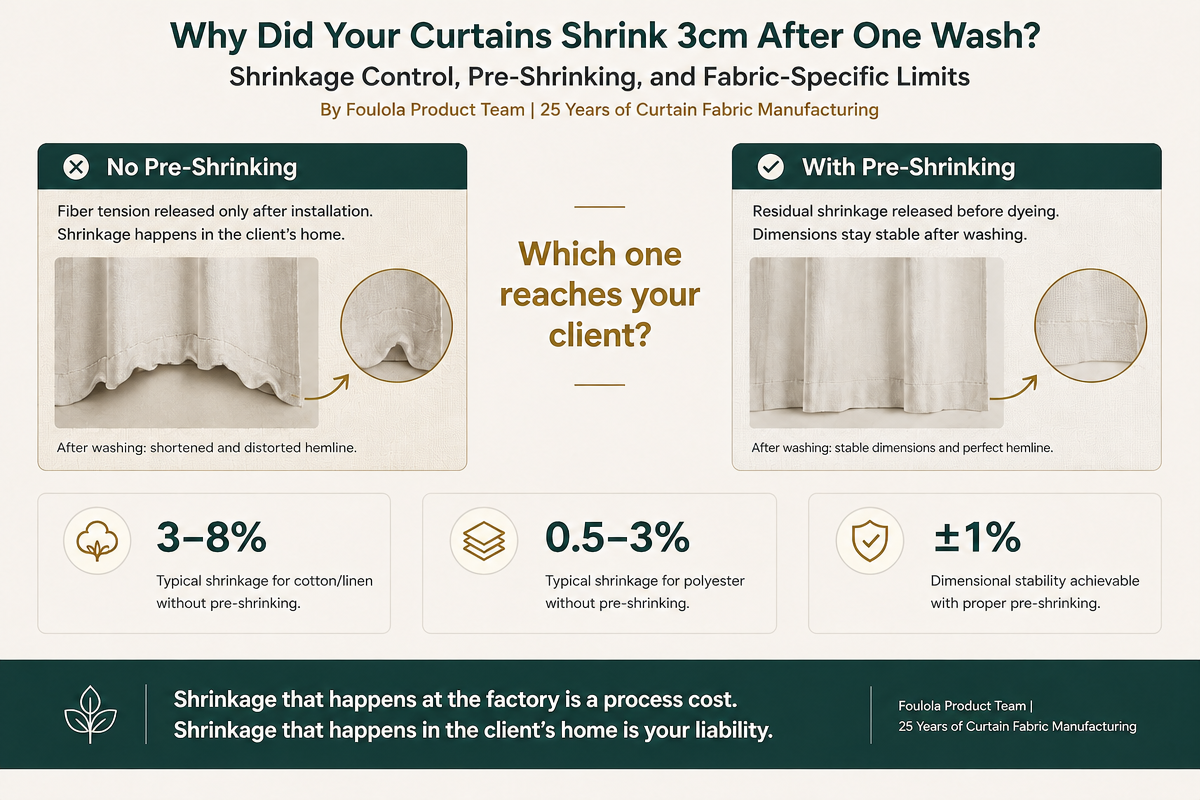
If you only remember one thing: shrinkage is not a "defect" that appears out of nowhere. It is a predictable physical behavior that either gets released at the factory or in your client's home. The article below gives you the standard limits, fabric-specific shrinkage data, the real cost of pre-shrinking, and a simple on-arrival test you can run yourself.
1. Why Is a "13cm Shrinkage" the Most Expensive Oversight in Your Procurement Chain?
Let's do some math.
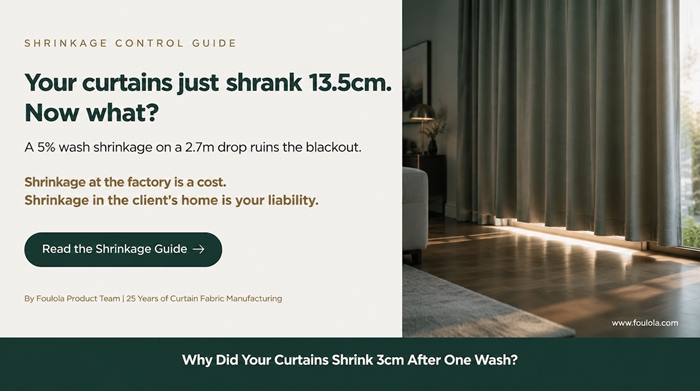
Imagine you are procuring floor-to-ceiling curtain fabric for a hotel guest room. The required drop (height) is 2.7 meters. The fabric has not been pre-shrunk, and its wash dimensional change rate is 5%.
After the first commercial wash, the 2.7-meter drop shrinks by 13.5 cm (2.7m × 5%).
If the curtain was originally installed to precisely touch the floor, the bottom hem now hovers 13.5 cm above the ground. Light and dust will leak through the gap, completely ruining the blackout integrity and the visual appeal of the room. The curtain is essentially ruined. The cost of re-manufacturing, plus uninstallation labor and project delays, all falls on you.
This is not a hypothetical scenario. In consumer mediation cases, curtains ordered at 7.8 meters arrived at 7.1 meters, with the merchant blaming "production loss." The case ended in a return and refund. In another case, a 7.6-meter curtain shrank to 6.8 meters. For fabric wholesalers and curtain shops, one such claim can wipe out the profit of an entire order. For hotel projects, the cost of schedule delays far exceeds the cost of the fabric itself.
The problem is that shrinkage is not bad luck. It is a physical behavior of fibers. It is predictable, testable, and controllable. This article answers three questions: where to control it, what standard to judge it by, and how to write it into your procurement contract.
2. What Is the Standard for Shrinkage? How Much Change Is Acceptable?
Before discussing control, we must define the standard.
The wash dimensional change rate of curtain fabrics is tested according to GB/T 8628 (preparation and marking of specimens) and GB/T 8630 (determination of dimensional change). The test procedure uses the 4N program in GB/T 8629 (simulating domestic washing), with line drying.
Different standards and projects have different tolerance requirements:
| Evaluation Scenario | Wash Dimensional Change Tolerance | Basis / Notes |
|---|---|---|
| Some government procurement projects (curtains) | Length: −4.0% to +3.0%; Width: −4.0% to +3.0% | Based on GB/T 8628 / 8629 / 8630 |
| Some finished curtain standards (First Grade) | Warp and weft within specific ranges (e.g., warp −2.5% to +2.5%, weft −2.0% to +2.0%) | Refers to relevant product standards under GB/T 8630 |
| High-end jacquard and natural blends (Post-pre-shrinking target) | Within ±1% | Dimensional stability target achieved through pre-shrinking |
| Some strict projects (curtains) | Length and Width: ±3.0% | Common agreement in procurement specs |
The key point is: standards provide an "allowed range," not a "target value." A contract stating "±3%" means a 3% shrinkage is legally compliant. However, for a 2.7-meter floor-to-ceiling curtain, a 3% shrinkage means 8.1 cm of shrinkage. The bottom hem will visibly hover above the floor, which is fatal for hotel blackout requirements.
This is why high-end projects aim for ±1%, rather than settling for the standard tolerance.
3. Why Do Cotton and Linen Shrink Much More Than Polyester?
The root cause of shrinkage is that fibers are stretched during weaving and dyeing. The residual tension is released upon contact with water. The fiber's moisture absorption and structure determine the degree of release.
| Fiber / Fabric Type | Typical Unfinished Shrinkage | Core Reason |
|---|---|---|
| Polyester | 0.5%–3% | Hydrophobic synthetic fiber; low moisture swelling; naturally good dimensional stability |
| Cotton | 3%–5% | Hydrophilic fiber; fiber swells upon moisture absorption; weaving tension released |
| Linen | 5%–8% | Stronger moisture absorption, high fiber rigidity, high weaving tension; shrinkage is usually higher than cotton |
| Cotton-Poly Blend | 2%–4% | Falls in between, depending on the blend ratio |
| Viscose / Rayon | Up to 10% | Low wet strength; highly prone to deformation and shrinkage |
| High-end Jacquard (Unfinished) | Depends on yarn and structure | Floats and multi-component yarn interlacing amplify dimensional instability |
A common misconception is that "polyester doesn't shrink." Polyester shrinkage is indeed low, but the 0.5%–3% range means that in a worst-case scenario, a 2.7-meter curtain could still shrink by 8 cm. For large-area floor-to-ceiling curtains, this is enough to cause a visibly uneven bottom hem.
The shrinkage risk for cotton and linen is much higher. Without pre-shrinking, the wash shrinkage rate is typically 3%–5% or even higher. If cut directly to finished dimensions, it is almost inevitable that the curtains will "become shorter and have uneven hems" after the first wash.
4. What Exactly Does Pre-Shrinking Do?
The core logic of pre-shrinking (Sanforizing) comes down to one sentence: Release the shrinkage that will happen in the future, right now at the factory.
During weaving, yarns are repeatedly stretched and interlaced, locking a massive amount of mechanical stress into the fabric. Standard pre-shrinking is typically performed before the dyeing process. By passing the fabric through a mechanical pre-shrinking machine (or a wash-relaxation process) under zero tension, the fabric is allowed to fully retract, returning the fibers to their natural state before entering the dyeing and finishing stage. Attempting to force relaxation after dyeing and heat-setting can easily damage the fabric's handfeel and color.
Unfinished fabric is like a stretched spring. After installation, exposure to air, temperature/humidity changes, and the first wash cause this stress to release, shrinking the fabric. The problem is that this release happens on your client's wall, not in the factory.
For high-end jacquard and natural blend fabrics, a standard "pre-shrinking before dyeing + post-finishing setting" process can control the dimensional stability of the finished curtain after domestic washing to within ±1%.
But pre-shrinking is not free.
5. What Is the Real Cost of Pre-Shrinking? Why Don't All Suppliers Do It?
The cost of pre-shrinking is not just the "processing fee for one step." It lies in time and material loss.
Time Cost. If pre-shrinking is skipped, the fabric goes straight from the loom to the dye vat, and can be delivered immediately after dyeing and setting—the lead time is extremely short. If pre-shrinking is added, the fabric must first pass through the pre-shrinking machine to relax and retract, then go into the dye vat, and finally be re-rolled. This extends the entire cycle's lead time by 1–2 days.
Material Loss. Pre-shrinking causes natural shrinkage. To ensure the delivered total meters meet the order, a legitimate factory must input extra material at the source. This means actual yarn and weaving labor inputs are higher than in direct production without pre-shrinking. The cost of the pre-shrinking process itself is estimated at roughly 7% of the textile's cost in the industry.
This is why "many peers are unwilling to do pre-washing—the core reasons are nothing more than time and cost." Fabric that skips pre-shrinking can be quoted lower, but the risk is transferred to the post-installation stage.
6. How Do You Write Shrinkage Requirements into a Contract?
Verbal agreements to "keep shrinkage small" are meaningless. What you need in a contract are terms that are quantifiable, testable, and enforceable.
First, specify the exact tolerance value and direction. Don't just write "complies with national standards." National standard tolerances may be wider than your project requires. Write directly: Wash dimensional change rate, warp and weft, not exceeding ±X% (e.g., recommend ≤±2% for hotel floor-to-ceiling curtains, ≤±1% for high-end projects).
Second, specify the test method and procedure. State that testing is based on GB/T 8628 and GB/T 8630, using the 4N program in GB/T 8629, with line drying. This prevents suppliers from using a different washing program (like the gentler 5A program) to "pass" the test.
Third, specify the testing timing and sample source. Clarify that the test results of samples drawn from the arriving batch are the standard, not "historical reports" provided by the supplier. You can agree that after arrival, the buyer has the right to sample and send for third-party testing, with the cost borne by the responsible party.
Fourth, distinguish between "fabric shrinkage" and "finished dimension deviation." These are two different issues. Fabric shrinkage is the dimensional change after washing; finished dimension deviation is the difference between the actual sewn size and the ordered size. The contract should address both separately. In the mediation cases, merchants tried to explain undersized finished products as "production loss." The mediation explicitly ruled that loss should be borne by the merchant and not passed on to the buyer.
Fifth, specify pre-shrinking requirements (if required by the project). If the project requires pre-shrunk delivery, state: "Fabric must be pre-shrunk. Upon arrival, tested according to the above method. If the wash dimensional change rate exceeds the agreed value, the buyer has the right to reject the goods or request a replacement."
7. How to Do a Simple Shrinkage Test on Arrival?
You don't need a spectrophotometer or a standard washing machine for preliminary screening. A 10cm × 10cm marked square and one simulated wash will expose most risks.
Step 1: Sampling. Randomly select fabric from the arriving batch, avoiding at least 10cm from the selvedge, and cut a flat sample.
Step 2: Marking. Use a waterproof or colorfast marker to draw a precise 10cm × 10cm square on the sample, marking the warp and weft directions.
Step 3: Simulated Washing. Wash according to standard domestic washing procedures (water temperature and detergent amount as close to actual use conditions as possible), and line dry.
Step 4: Measurement & Calculation. Measure the dimensions between the marked lines again after drying. The formula:
Dimensional Change Rate (%) = (Post-wash Dimension − Pre-wash Dimension) / Pre-wash Dimension × 100%
Step 5: Judgment. If the change rate in the warp or weft direction exceeds the contractually agreed tolerance (or exceeds the project's acceptable risk threshold), this batch of fabric should not proceed to the cutting stage. Finding problems before cutting means you still have the negotiating leverage.
8. A 25-Year Fabric Factory's Observation on Shrinkage Control
Over 25 years of production, Foulola has observed a shift in where shrinkage issues occur in the procurement chain. In the past, buyers often "discovered" shrinkage after installation, making accountability difficult. Now, more and more wholesalers and project buyers are making the wash dimensional change rate a mandatory inspection item upon arrival, rather than waiting for after-sales disputes to arise.
For high-end jacquard and natural blend product lines, pre-shrinking is a standard factory process, aiming to keep the dimensional stability of the finished curtain after domestic washing within the ±1% range. For standard polyester products, the factory inspection report will clearly state the actual measured wash dimensional change rate, allowing buyers to compare it with the contract tolerance.
This is not marketing rhetoric about "our shrinkage rate is lower than others." This is a metric that can be verified, agreed upon, and enforced in the procurement process. If you are looking for a supplier, ask one specific question: "What is the actual measured wash dimensional change rate of this batch, and what test procedure was used?" A supplier who can answer this directly is far more worth pursuing than one who simply says "our quality is very good."
9. Conclusion: Shrinkage Is Not a Matter of Luck, It's a Matter of Process
Back to the opening question: why did your curtains shrink so much after one wash?
Because the shrinkage was not controlled at the stage where it should have been. Fiber shrinkage is a physical inevitability. The only difference is whether it happens before dyeing at the factory, or in your client's home.
-
Standards provide the bottom line, not the target. A ±3% contract tolerance means 3% shrinkage is compliant, but for 2.7-meter floor-to-ceiling curtains, you likely need to aim for ±1%–2%.
-
Fabric type determines the risk level. Cotton and linen carry much higher risks than polyester; high-end jacquard and blends require additional process control.
-
The cost of pre-shrinking is explicit; the cost of skipping it is hidden. Pre-shrinking consumes time and material, but it keeps after-sales claims, rework, and reputational damage behind the factory gates.
-
Contract clauses and on-arrival testing are your two lines of defense. Write the tolerances, methods, and testing timing clearly; use the 10cm mark test to screen before cutting.
Finding problems while you still have negotiating leverage is always cheaper than finding them during a client's complaint call.
This article is part of Foulola's B2B Educational Series. For technical specifications, test reports, or sample requests, please visit www.foulola.com or contact your sales representative.
References
National Standards (China):
-
GB/T 8628-2013, Textiles – Preparation, Marking and Measuring of Fabric Specimens and Garments in Tests for Determination of Dimensional Change.
-
GB/T 8629-2017, Textiles – Domestic Washing and Drying Procedures for Textile Testing.
-
GB/T 8630-2013, Textiles – Determination of Dimensional Change in Washing and Drying.
Industry and Procurement References:
-
Technical specifications from publicly available procurement notices for curtain projects, specifying wash dimensional change tolerances and test methods.
-
Market supervision and consumer mediation case reports on curtain dimensional disputes (Haining and Suzhou economic development zones).
Table of Contents
- Why Did Your Curtains Shrink 3cm After One Wash? A Guide to Shrinkage Control
- 1. Why Is a "13cm Shrinkage" the Most Expensive Oversight in Your Procurement Chain?
- 2. What Is the Standard for Shrinkage? How Much Change Is Acceptable?
- 3. Why Do Cotton and Linen Shrink Much More Than Polyester?
- 4. What Exactly Does Pre-Shrinking Do?
- 5. What Is the Real Cost of Pre-Shrinking? Why Don't All Suppliers Do It?
- 6. How Do You Write Shrinkage Requirements into a Contract?
- 7. How to Do a Simple Shrinkage Test on Arrival?
- 8. A 25-Year Fabric Factory's Observation on Shrinkage Control
- 9. Conclusion: Shrinkage Is Not a Matter of Luck, It's a Matter of Process
- References

