
 EN
EN

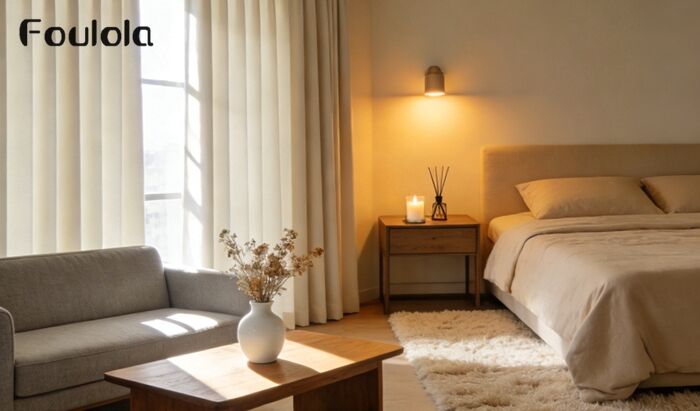
Are the curtains in your home truly "qualified"?
When most people buy curtains, they focus on color, fabric feel, and price. Few ever ask: What's its color fastness rating? Does it meet formaldehyde limits? Is the blackout rate accurate?
As the largest soft furnishing in any home, curtains spend every day with your family. Their "inner quality" matters far more than appearance.
Today, let's use the yardstick of national standards to measure the gap between "ordinary curtains" and "truly good curtains."
I. First, Let's Clarify: What Are National Standards vs. Factory Standards?
National Standards (GB) : Mandatory or recommended standards set by the state—the "passing line" for products to enter the market. Meeting them means "it can be sold," but not necessarily "good enough."
Factory Standards : Higher standards set by manufacturers themselves. Companies willing to stand behind their factory standards typically hold themselves to a higher bar.
At Foulola, our internal standards far exceed national requirements. This isn't for show—we believe that "passing" is just the baseline; what we should deliver is products that are truly durable, reliable, and bring peace of mind.
II. 5 Key Indicators: How to Read a Curtain's True Quality
1. Color Fastness: Will It Fade After a Few Washes?
1)National Standard Requirement: Color fastness for household textiles typically requires Level 3-4 (Level 5 is highest).
2)"Passing" Performance: Level 3-4 curtains work fine for daily use, but may show visible fading after multiple washes or prolonged sun exposure.
3)"Excellent" Performance (Foulola Standard) : We require all dark fabrics to achieve Level 4 or higher, and light fabrics Level 4.5 or higher. This means your curtains will retain their color even after three years and a dozen washes.
4)What to Look for on Reports: Look for "color fastness to washing" and "color fastness to light"—higher numbers are better.
2. Formaldehyde Content: Does It Have an Unpleasant Odor?
1)National Standard Requirement: According to GB 18401, curtains fall under "Category C (not intended for direct skin contact)" and formaldehyde content must not exceed 300mg/kg.
2)"Passing" Performance: ≤300mg/kg. Many ordinary curtains meet this, but may still have some odor when first unpacked.
3)"Excellent" Performance (Foulola Standard) : We require all fabrics to have formaldehyde content ≤75mg/kg, far below the national limit. We even require suppliers to provide "infant-safe" level certifications.
When you receive our curtains, there's virtually no smell upon opening.
4)What to Look for on Reports: Check the "formaldehyde content" column—lower numbers are better. If the report says "not detected," it means the level is below the test's detection limit, which is ideal.
3. Blackout Rate: Is the Claimed "Total Blackout" Real?
1)National Standard Requirement: No mandatory standard exists, but industry classifications are generally:
Total Blackout: ≥99% blackout rate
High Blackout: 90%-98%
Semi-Blackout: 50%-80%
Decorative: ≤50%
2)"Passing" Performance: Many sellers claim "total blackout," but actual rates are around 80%, still letting light through during the day.
3)"Excellent" Performance (Foulola Standard) : Our physical blackout fabric (three-layer woven construction) achieves a measured blackout rate of 90-95% ,
providing effective light blocking for most households' sleep needs. For coated blackout fabrics, we clearly disclose their pros and cons (e.g., not washable, shorter lifespan) and never hide the truth.
4)What to Look for on Reports: Authorized test reports will list specific "blackout rate" or "light transmission rate" values. Lower transmission equals better blackout.
4. Flame Retardancy: If a Fire Occurs, Will Curtains Become Fuel?
1)National Standard Requirement: Curtains in public spaces must meet Class B1 (flame retardant). There's no mandatory requirement for home use, but many premium products offer flame-retardant treatment.
2)"Passing" Performance: Most ordinary household curtains lack flame-retardant treatment and will burn quickly if exposed to open flame.
3)"Excellent" Performance (Foulola Standard) : For clients with special needs (e.g., homes with elderly or children, or for use in B&Bs, rental properties),
we offer Class B1 flame-retardant fabric options that meet SGS-tested NFPA701 flame retardancy standards. They self-extinguish when the flame source is removed, adding an extra layer of safety for your home.
4)What to Look for on Reports: Check "burning performance" or "flame retardancy class." Class B1 is the best, and reaching NFPA701 standards indicates high-level international certification.
5. Coating Safety: Is the "Glue" Behind Blackout Curtains Safe?
1)National Standard Requirement: Coating materials must meet environmental standards and contain no prohibited substances.
2)"Passing" Performance: Ordinary coated blackout fabrics may use solvent-based coatings, which can release volatile organic compounds (VOCs) over time.
3)"Excellent" Performance (Foulola Standard) : We prioritize "physical blackout fabric"—achieved through three-layer weaving without any coating. It's both eco-friendly and breathable, and can even be washed.
If a client specifically needs coated blackout fabric, we use only water-based acrylic resin coatings, which are non-toxic, odorless, and meet higher environmental standards.
4)What to Look for on Reports: Check the coating material test report to confirm it's "water-based," "solvent-free," and compliant with GB 18401.
III. At a Glance: Ordinary Curtains vs. High-Quality Curtains
|
Indicator |
Ordinary Curtains (Passing) |
High-Quality Curtains (Foulola Standard) |
|
Color Fastness |
Level 3-4, may fade after years |
Level 4-4.5, stays vibrant for years |
|
Formaldehyde Content |
≤300mg/kg, may have slight odor |
≤75mg/kg, virtually odorless |
|
Blackout Rate |
Claims "total blackout" but often exaggerated |
Measured 90-95%, transparently disclosed |
|
Flame Retardancy |
Mostly untreated |
Class B1 option available (meets NFPA701) |
|
Coating |
May use solvent-based |
Water-based eco-coating or physical blackout |
|
Test Reports |
Either unavailable or only summary provided |
Proactively provided, with verifiable raw data |
IV. For Customers: How to Tell If a Seller Is Telling the Truth?
1. Ask for Test Reports
Reputable manufacturers conduct regular third-party testing. If a seller claims "our quality is great" but can't produce a report, be cautious.
2. Know What to Look for in a Report
1)Was the report issued by a nationally accredited third-party testing agency? (e.g., SGS, National Textile Products Quality Supervision and Testing Center)
2)Does the product name/model on the report match what you're buying?
3)Pay special attention to color fastness, formaldehyde, and blackout rate.
3. Request Fabric Samples and Test Yourself
1)Color Fastness: Rub a white damp cloth vigorously against the fabric to see if color transfers.
2)Formaldehyde: Smell the fabric when unpackaged—any strong chemical odor?
3)Blackout Rate: Hold it up to a bright light source, or place your phone's flashlight against the back to see how much light passes through.
4. Ask Specific Questions About Craftsmanship
1)"Is the coating water-based or solvent-based?"
2)"How many layers is the physical blackout fabric?"
3)"How many times has the fabric been heat-set?"
V. A Final Word
In our 25 years at Foulola, we've seen far too many curtains that "looked the same on the surface but performed completely differently underneath."
Some customers said: "My last curtains shrank after one wash."
Others said: "They claimed total blackout, but I was awake at 5 AM."
Still others: "After two years, the color faded beyond recognition."
These regrets all trace back to focusing on looks over quality.
We believe a good curtain should withstand not only national standards but also the test of time. We proactively share our test reports—not because we need to prove anything, but because we know that true quality has nothing to hide.
If you're choosing curtains, it's worth asking: "Do you have test reports? May I see them?"
That one question might just help you avoid 90% of potential pitfalls.