
 EN
EN

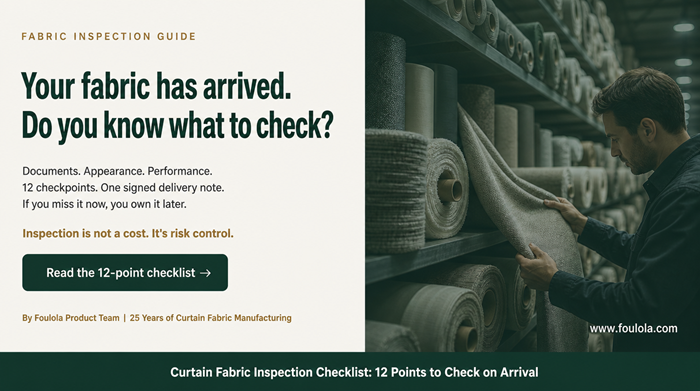
Curtain Fabric Inspection Checklist: What to Check on Arrival (12-Point Guide)
A Practical Guide for Fabric Wholesalers, Curtain Shops, Interior Designers, and Hotel Buyers
By Foulola Product Team | 25 Years of Curtain Fabric Manufacturing
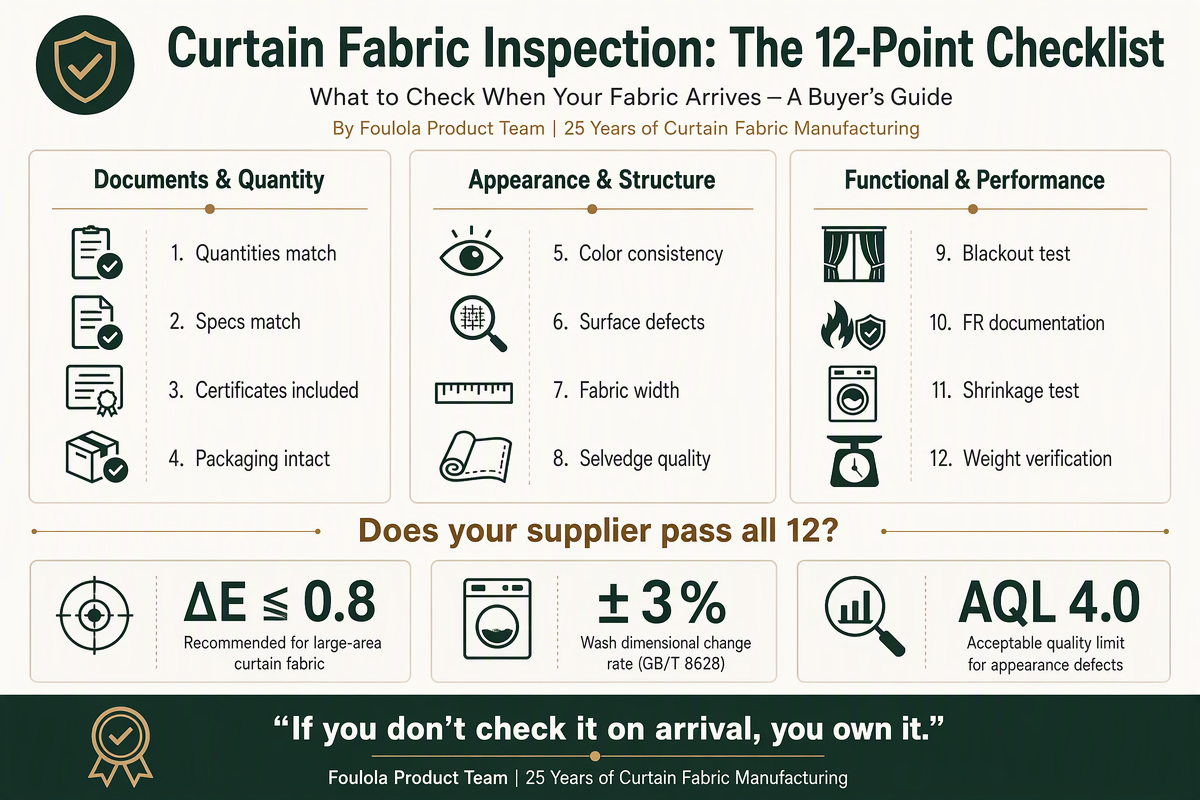
If you only remember one thing: what you don't check on arrival becomes your problem later. The article below gives you a 12-point inspection checklist, defect grading standards, and a rejection workflow you can use on your next shipment.
1. Why Is Arrival Inspection the Weakest Link in Your Procurement Chain?
Let me ask you a question.
Your fabric has arrived. Three rolls, five rolls, or a full container. The packaging looks fine. The driver is waiting for your signature on the delivery note. Your warehouse manager asks: "Should we open it up and check?" You say: "Just sign for it. We'll deal with it later."
Then what happens? Three months later, the installer reports: "Some rolls don't match in color." Or six months later, the housekeeping manager complains: "The curtains shrank after two washes."
Now you go back to your supplier. And the answer you get is probably: "Why didn't you check when the goods arrived?"
This isn't one buyer's problem. It's the most overlooked step in the entire procurement chain. Many buyers only check quantity and outer packaging on arrival. They discover color differences, skipped threads, shrinkage, or undersized dimensions only after installation is complete.
For fabric wholesalers and curtain shops, one color discrepancy claim can wipe out the profit on an entire order. For hotel procurement, a batch of non-compliant fabric leads to rework and schedule delays that affect the entire project's opening timeline.
This article gives you a framework you can use directly. Not theory. An operational checklist.
2. What Documents Should You Check First? Without These, Nothing Else Matters
The first step of inspection is not touching the fabric. It's checking the paperwork. If the documents aren't complete, the physical inspection is meaningless.
Check 1: Does the quantity and specification match the contract?
On arrival, first confirm that all goods—curtains, tracks, gliders, mounting hardware—match the procurement list, technical specifications, and contract in terms of model, quantity, and dimensions. No missing items, wrong items, or short shipments. This sounds simple, but specification errors are not rare. Especially with multi-color, multi-width orders, different specifications get mixed into the same package. If you don't verify item by item, you'll discover at installation that a certain color fabric is missing.
Check 2: Are the accompanying documents complete?
On arrival, the shipment must include an environmental performance test report issued by a legally authorized testing body, covering formaldehyde, heavy metals, and harmful dyes. Test results must comply with procurement requirements and current national environmental standards—otherwise, the shipment is considered non-compliant. The shipment should also include a product certificate, factory inspection report, environmental test report, and legal quality test report (issued by a local fiber inspection institute). All documents must be authentic and valid.
Check 3: Is the outer packaging intact?
Outer packaging must be undamaged—no moisture, deformation, or tears. Fabric that has been exposed to moisture can develop mold and odor. These problems are hard to detect inside the packaging, but once mold sets in, the entire roll is essentially ruined.
Check 4: Does the physical product match the approved sample?
If you confirmed a pre-production sample before mass production, you must open at least one roll on arrival and compare it against that sample. Check color, handfeel, and texture. This step catches batch deviations at the earliest possible moment.
3. What Should You Look For in the Visual Inspection? Four Easily Missed Details
Once the documents check out, move to visual inspection. You don't need to unroll every single roll, but you must do sampling. According to GB/T 2828.1-2012, normal inspection single sampling plans, appearance quality should be inspected at General Inspection Level I, with an Acceptable Quality Limit (AQL) of 4.0.
Check 5: Is the color difference within tolerance?
Color difference is the single highest-claim quality dispute in curtain fabric. The reason is practical: fabric is a large-area installation product. If curtains in the same room use different production batches, even a tiny color difference gets amplified by natural light into something the human eye immediately notices.
The industry commonly uses Datacolor or X-Rite spectrophotometers to read CIELAB color difference values (ΔE). General apparel fabric requires ΔE ≤ 1.0. For large-area home textile installations, ΔE ≤ 0.8 is recommended. For engineering projects with multiple curtain panels in the same space, ΔE ≤ 0.5 may be required. Finished curtain appearance standards require same-window color difference of at least Grade 4-5, and same-batch color difference of at least Grade 3-4 (per T/HOMETEX 6-2019, Finished Curtains).
In practice, if you don't have a spectrophotometer, use the "visual comparison method": under natural light, place the arriving fabric next to the approved sample at a distance of 60cm. If you can see a clear difference with the naked eye, it's worth further instrument testing.
Check 6: Are there surface defects?
Curtain fabric must be free of stains, skipped threads, and defects, with uniform color. Specifically: holes are not permitted; needle marks should be inconspicuous and under 20cm in length; color stains at Grade 4 are permitted up to 1 spot per piece; linear defects are permitted up to 2 spots per piece if minor.
Tip: Use a flashlight at a low angle across the fabric surface during inspection. This makes skipped threads and weft bars much easier to spot than looking straight on.
Check 7: Are the width and dimensions compliant?
Finished curtain dimension tolerances: width −1cm, height −3cm to +3cm. If you're receiving fabric rolls, verify the actual width matches the contract. Insufficient width increases splicing during cutting, which directly increases material cost.
Check 8: Are the selvedges clean and even?
Side hemming should be no less than 2cm and uniform in width. Bottom edges should be straight; side edges should not twist. Fabric with uneven selvedges causes curling and needle deflection during sewing, increasing processing waste.
4. How Do You Verify Functional Performance? Four Points Buyers Often Skip
Visual inspection passed. But does the fabric actually meet its functional specifications? This section requires data, not impressions.
Check 9: Blackout rate verification
Blackout rate is the most critical functional metric for hotel curtains. Finished curtain blackout rates should comply with FZ/T 62025-2015. During inspection, place a fabric sample against a strong light source and observe light transmission from the reverse side. For precise data, use a blackout rate tester or spectrophotometer.
Check 10: Flame retardancy documentation
If the project has flame retardancy requirements, verify the key data in the test report: damaged length ≤150mm, afterflame time ≤5s, afterglow time ≤5s, limiting oxygen index ≥32%. The test report must be issued by a third-party testing body accredited with CMA qualifications.
Check 11: Wash dimensional change rate
Wash dimensional change rate testing follows GB/T 8628-2013 and GB/T 8629-2017. Curtain fabric wash dimensional change rate should be within −3% to +3%. Industry data shows that warp change of ±3% and weft change of ±4% are common tolerance ranges, with shrinkage typically required to be ≤2%.
For hotel projects, pay attention to dimensional change after 20 washes. Industry reference value: ≤5%. During inspection, you can cut a small fabric sample for a simple wash test: mark a 10cm × 10cm square, wash and dry per standard procedure, then measure the change.
Check 12: Weight and tensile strength verification
Fabric weight directly affects blackout, drape, and durability. Weight data in the test report should comply with GB/T 4669-2008. Tensile strength requirements: warp ≥1200N, weft ≥360N (per GB/T 3923.1-2013).
5. How Do You Grade Defects? What's Acceptable vs. What Must Be Rejected?
Not every flaw equals non-compliance. The key is grading defects and judging against a standard.
The industry-standard "4-Point System" grades defects by length: defects ≤8cm score 1 point; >8cm to 16cm score 2 points; >16cm to 24cm score 3 points; >24cm to 100cm score 4 points.
Based on severity, defects fall into three grades:
| Defect Grade | Criteria | Action |
|---|---|---|
| Critical | Holes, tears, severe color difference (ΔE > 2.0), functional metrics non-compliant | Reject entire batch, require free replacement |
| Major | Visibly obvious skipped threads, weft bars, stains (single spot > 2cm), severely uneven selvedges | Negotiate price reduction or request replacement |
| Minor | Slight needle marks, linear defects (2 spots/piece permitted), slight color stains (Grade 4, 1 spot/piece permitted) | Acceptable, record for file |
If testing reveals non-compliant indicators, the related testing costs are borne by the supplier, and the buyer has the right to reject the shipment.
6. How Do You Handle Rejection and Claims? A Workflow You Can Use Directly
After discovering non-compliant goods, the most important thing is to complete written notification within the contractually agreed inspection period. Most contracts specify that the buyer should inspect the purchased curtain products within 7 days of receipt and notify the seller of the inspection results. If inspection fails, the buyer has the right to request return or replacement.
The complete rejection workflow should follow these steps:
Step 1: Document with photos. Take multi-angle photos of non-compliant goods, including full views, close-ups, and comparison shots with the approved sample. Photos should include a reference object (such as a ruler) to show scale.
Step 2: Written notification. Within the inspection period, send a written quality objection notice to the supplier, attaching photos and inspection records. The notice should clearly state the non-compliant items, the basis for judgment (citing specific standard clauses), and the required resolution (replacement/price reduction/return).
Step 3: Third-party testing. If the supplier disputes the quality judgment, commission a third-party testing body with CMA/CNAS accreditation to conduct arbitration testing.
Step 4: Negotiated resolution. Based on test results and contract terms, negotiate the final resolution. If the contract specifies penalty clauses, execute per contract.
7. How a 25-Year Fabric Factory Views Inspection Standards
Over 25 years of production, Foulola has observed that buyer inspection awareness and capability have improved noticeably over the past five years. More and more clients proactively verify test reports, compare against approved samples, and conduct simple wash tests on arrival. These actions may seem to add workload at the receiving stage, but they actually reduce after-sales costs and communication costs later.
At the factory level, Foulola products ship with complete test reports and factory inspection records. For projects with specific inspection requirements, we can also support arrival re-inspection, third-party testing, and provide bulk production retention samples for client comparison.
For fabric wholesalers and curtain shops, establishing a standardized inspection process not only protects your profit margins but also builds clearer quality consensus in long-term supplier relationships. If you're looking for suppliers who can provide complete test reports and bulk retention samples, start by screening for one capability: "Can they support arrival re-inspection?"
Inspection isn't about finding fault. It's about exposing problems at the right point in time. Problems found on arrival are the supplier's problems. Problems found after installation are your problems.
8. Conclusion: Inspection Is Not a Cost—It's Risk Control
The core logic of arrival inspection comes down to one sentence: Find problems while you still have negotiating leverage.
The 12-point checklist, defect grading standards, rejection workflow—the value of this framework isn't that you'll use every step every time. It's that you'll know when to check, what to check, and how to judge.
Documents complete before touching the fabric. Sampling based on standards. Color judged by data. Functional metrics verified by reports. Non-compliant goods notified in writing within the inspection period.
With these actions, you don't need to become a fabric expert to block most risks before you sign.
This article is part of Foulola's B2B Educational Series. For technical specifications, test reports, or sample requests, please visit www.foulola.com or contact your sales representative.
References
National Standards (China):
-
GB/T 2828.1-2012, Counting Sampling Inspection Procedures – Part 1: Lot-by-Lot Inspection Sampling Plans Indexed by Acceptable Quality Limit (AQL).
-
GB/T 8628-2013, Textiles – Preparation, Marking and Measuring of Fabric Specimens and Garments in Tests for Determination of Dimensional Change.
-
GB/T 8629-2017, Textiles – Domestic Washing and Drying Procedures for Textile Testing.
-
GB/T 3923.1-2013, Textiles – Tensile Properties of Fabrics – Part 1: Determination of Maximum Force and Elongation at Maximum Force Using the Strip Method.
-
GB/T 4669-2008, Textiles – Woven Fabrics – Determination of Mass per Unit Length and Mass per Unit Area.
-
GB 18401-2010, National General Safety Technical Code for Textile Products.
Industry Standards:
-
FZ/T 62025-2015, Coated Roller Blind Fabric.
-
T/HOMETEX 6-2019, Finished Curtains, China Home Textile Association.
Government Procurement References:
-
Technical specifications compiled from publicly available government procurement notices for curtain and window treatment projects, including requirements for shading rate, fabric weight, dimensional stability, formaldehyde content, and flame retardancy.
Table of Contents
- Curtain Fabric Inspection Checklist: What to Check on Arrival (12-Point Guide)
- 1. Why Is Arrival Inspection the Weakest Link in Your Procurement Chain?
- 2. What Documents Should You Check First? Without These, Nothing Else Matters
- 3. What Should You Look For in the Visual Inspection? Four Easily Missed Details
- 4. How Do You Verify Functional Performance? Four Points Buyers Often Skip
- 5. How Do You Grade Defects? What's Acceptable vs. What Must Be Rejected?
- 6. How Do You Handle Rejection and Claims? A Workflow You Can Use Directly
- 7. How a 25-Year Fabric Factory Views Inspection Standards
- 8. Conclusion: Inspection Is Not a Cost—It's Risk Control
- References

