
 EN
EN

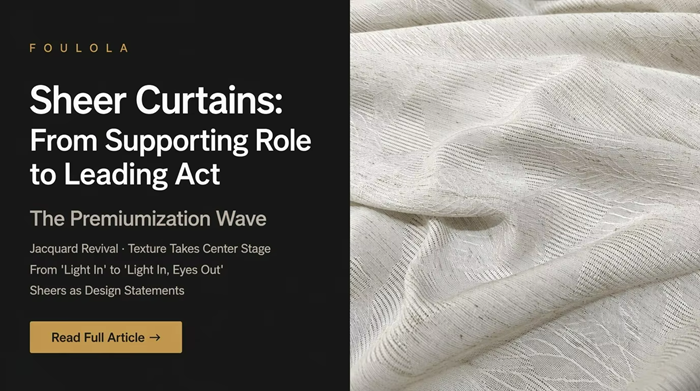
1. Introduction: The Quiet Rise of a Sheer
A noticeable shift is taking place across the curtain industry — more and more showrooms are placing sheer curtains in their most prominent display positions. A yarn-dyed jacquard wool-blend sheer is being increasingly recommended to customers: “This sheer is substantial enough to be used as drapery or as a sheer, perfect for living rooms and studies — it looks beautiful as a standalone hanging.” Industry observers have also noted that younger consumers are becoming increasingly receptive to sheers — “more and more customers are choosing sheers directly for their living rooms and balconies.”
Sheer curtains are quietly staging a comeback.
There was a time when sheers were merely the “supporting act” in the curtain family — a thin, optional layer with limited function and perceived value. But today, sheers are redefining window aesthetics as leading players in their own right. From “single-layer sheers” to “double-layer sheers,” from living rooms to studies, from residential homes to hotels, sheers are no longer just curtain accessories — they are becoming the active choice of more and more consumers. Data shows that sheer curtain sales as a proportion of some curtain businesses have risen from 20–30% to over 50%, becoming a new growth driver.
What is driving this transformation from “supporting role” to “leading act”? How has the sheer curtain category evolved from a thin layer of fabric toward “premiumization”? This article unpacks the evolution of the sheer curtain category through three dimensions: market data, consumption trends, and design upgrades.
2. An Expanding Market
In 2025, the global curtain market was valued at approximately $23.99 billion, projected to reach $25.3 billion in 2026, with a compound annual growth rate of 5.5%. Key growth drivers include rising residential construction, expanding urban housing development, increased spending on interior decor, and the expansion of hospitality and commercial spaces. The curtain fabric market is growing even faster — valued at $14.8 billion in 2025, it is projected to reach $16.03 billion in 2026 and $23.88 billion by 2031, with a CAGR of 8.3%.
As a significant subcategory of curtains, sheers are also maintaining steady growth. The global sheer curtain market reached $4.2 billion in 2025 and is projected to grow to $6.3 billion by 2034, with a CAGR of 5.3%.
But this is not just about volume growth — it represents a qualitative leap.
3. The Deep Shift in Consumer Logic
The rise of sheers is first and foremost rooted in profound changes in consumer behaviour.
3.1 From “Ornate” to “Minimalist” Aesthetics
“The move from complexity to simplicity has been an undeniable reality in the curtain and sheer market over the past few years.” The once-popular ornate European patterns and heavy drapes are falling out of favour, replaced by solid colours, linen textures, and clean, simple lines.
The core driver of this trend is the rise of younger consumers. The 25-to-35 age group has become the primary purchasing force for sheer products. They embrace the “less is more” philosophy, prioritising spatial transparency and the quality of light. For them, a simple sheer provides privacy without sacrificing natural light, while creating a sense of atmosphere — exactly the lifestyle they desire. In 2025, minimalist sheers were hailed by the media as the “dark horse” of the home soft furnishings market and the “trendy winner” among young consumers.
3.2 The “Light Renovation, Heavy Decor” Consumption Philosophy
Behind the surge in sheer sales lies a deeper shift in consumer demand. Younger generations favour “light renovation, heavy decoration” — sheers are lighter, more translucent, and more ethereal than traditional drapes, making them ideal for creating a warm ambience.
At the same time, the proliferation of large balconies and floor-to-ceiling windows has given sheers greater scope to showcase their translucency — maximising daylight while providing privacy. “With living rooms and balconies becoming larger, the volume of sheers being used has increased significantly.”
New styling approaches have also boosted sheer sales. Combinations like “single-layer sheers” and “double-layer sheers” are becoming mainstream choices for young consumers. A growing number of customers are choosing two layers of sheers — one translucent, one shading, or two layers with different textures — creating an unprecedented sense of spatial layering.
| Consumption Trend | Manifestation | Driving Factor |
|---|---|---|
| Aesthetic shift | From ornate patterns to solid colours, linen textures, clean lines | Rise of 25–35 year-old consumers |
| Consumption philosophy | “Light renovation, heavy decoration,” pursuit of lightness and ambience | Upgraded spatial aesthetics |
| Spatial changes | Large balconies and floor-to-ceiling windows increase sheer demand | Changing housing layouts |
| Styling innovation | “Single-layer sheers” and “double-layer sheers” become new trends | Enhanced design awareness |
4. The Path to Sheer “Premiumization”
If changing consumer demand is the “pull” driving the rise of sheers, then product upgrades are the “push.” Sheers are undergoing a transformation from “supporting role” to “leading act” — and the essence of this transformation is the “premiumization” of the category.
4.1 From “Translucent Cloth” to “Fabric with Content”
The traditional functional positioning of sheers was singular: light transmission. But today’s sheers are being endowed with more value — design sensibility, texture, layering, and functionality.
“We have developed a wide range of sheer styles — jacquards and those with subtle textures are particularly popular with young clients and are selling well.” Behind this statement lies a reality: sheers are no longer just “a layer of thin fabric” — they can be jacquard, embroidered, printed, or cutwork.
Jacquard sheers, in particular, deserve attention. The variety of new jacquard sheer styles continues to expand, and orders for new sheer styles are growing steadily. The industry is moving from “solid-colour saturation” toward “differentiated competition” — the return of jacquard, printed, and embroidered fabrics is giving sheers a richer vocabulary of expression.
Finding the right balance between base fabric density and jacquard openness has become a central challenge in premium sheer design. By day, silhouettes appear softly blurred at the window; by night, the sheer glows with a gentle pearl-like lustre under artificial light. This “light in, eyes out” effect is a hallmark of the premiumization of sheers.
4.2 Craft Upgrades: The Renaissance of Jacquard
Jacquard craftsmanship plays a pivotal role in the premiumization of sheers.
Jacquard is not printed on or embroidered onto the fabric — it is woven in. Through the interplay of warp and weft threads, the pattern is constructed directly at the structural level of the fabric. This process gives sheers a distinctive quality: subtle from a distance, rich with detail up close.
In 2026, jacquard sheers are evolving in several clear directions:
-
Tone-on-Tone Jacquard: Same-colour shadow patterns that emerge and recede with light — a quintessential expression of “Quiet Luxury” in sheers
-
Textural Jacquard: Variations in yarn thickness and weave density create subtle tactile layers on the fabric surface
-
Metallic Jacquard: Metallic-lustre yarns are woven into the pattern, creating subtle shimmering effects as light moves across the fabric
The popularity of “gold-dust” sheers confirms this trend — micro-grade metallic yarns blended with high-count jacquard weave allow light to filter softly through the fabric, preserving transparency while adding refined visual depth.
4.3 Cross-Border Imagination: The Boundaries of Sheers Are Expanding
The premiumization of sheers is not limited to craft upgrades — it also extends to expanding application scenarios.
A textile manufacturer in Zhejiang spent 14 months perfecting a single sheer fabric, eventually using it for bridal gowns. This is not an isolated case. From curtains to apparel, from home textiles to haute couture, the imagination of sheers is being continuously redefined. As industry insiders put it, “The imagination of a sheer goes far beyond the window” — it is no longer confined to windows, but can enter fashion, accessories, art installations, and beyond.
5. From Trend to Product: One Factory’s Practice
The premiumization of sheers is not just talk — in the curtain manufacturing sector, some factories are responding with tangible products.
In Shaoxing, Foulola, with 25 years of deep expertise in textiles, has observed a structural shift in the sheer category: clients are no longer satisfied with “just letting light through” — they are now asking “what texture is this,” “what craft is this,” and “how will it look when hung.” Sheers are transitioning from functional products to design products.
Several of Foulola‘s sheer collections respond to this trend. Take the 2628-7# Jacquard Line-Drawn Floral Sheer, for example — this sheer uses large-scale jacquard weaving, where the floral pattern is not printed but woven through the interplay of warp and weft floats. On a pure white base, the floral motif emerges entirely through structural light-and-shadow contrasts: subtle from a distance, floral shadows shifting up close. This “tone-on-tone” jacquard effect is a quintessential expression of sheer premiumization.
The 2668-7# Metallic Peony Jacquard Sheer combines jacquard with metallic threads — the peony pattern is woven into the fabric, with metallic yarns catching the light. As daylight shifts, the pattern emerges and recedes, its lustre flowing with the sun’s movement. This is not only a display of craft but a response to the market demand for sheers “with content.”
The MNHY series (Thousand Li of Rivers and Mountains, Forest Botanical, Harvest Wheat, and other metallic jacquard sheers) pushes jacquard toward richer narrative expressions — weaving cultural symbols and natural imagery into the fabric. The 3.0m width allows landscape scrolls to unfold seamlessly across expansive windows.
For Foulola, the premiumization of sheers is not a marketing concept but an ongoing industry reality. When clients are willing to invest thought into selecting textures, comparing crafts, and experiencing light effects for a single sheer — sheers are no longer playing a supporting role.
6. The Revaluation of the Sheer Category
The transformation of sheers from supporting role to leading act is, at its core, a revaluation of the category.
In the past, the value of sheers was defined as “transparency + decoration” — simple, inexpensive, and interchangeable. But today, sheers are being endowed with new dimensions of value:
| Value Dimension | Traditional Sheers | Premium Sheers |
|---|---|---|
| Functional positioning | Light transmission, basic coverage | Light + privacy + ambience + design |
| Craft level | Plain weave | Jacquard, embroidery, metallic yarn, textured weave |
| Aesthetic value | Monotonous, flat | Layered, detailed, narrative-rich |
| Spatial role | Supporting act for curtains | Leading act for the space |
| Consumer group | Mass market | Design-conscious young consumers |
| Application scenarios | Windows | Windows + partitions + decor + cross-industry applications |
This revaluation is driven from both supply and demand sides.
On the demand side, 25-to-35-year-old consumers are redefining what a “good sheer” should be — no longer just “light in, eyes out,” but “subtle from a distance, refined up close.” They are willing to pay a premium for good design, good texture, and good craftsmanship.
On the supply side, the maturation of jacquard technology and the rise of design consciousness have given sheers the technical foundation to move from “flat” to “dimensional.” The proliferation of jacquard, embroidery, cutwork, and metallic yarn techniques is moving sheers away from the homogenised competition of “one thousand sheers looking the same.”
When the value of sheers is no longer underestimated, they naturally cease to be supporting players.
7. Conclusion: The “Age of the Leading Act” for Sheers
The premiumization wave of the sheer category is not a passing trend — it is a structural industry upgrade.
It is rooted in a profound shift in consumer aesthetics — “less is more” replacing “ornate complexity,” texture replacing quantity, detail replacing ostentation. It is enabled by continuous craft advancement — jacquard weaving giving sheers “content,” metallic yarns giving sheers “lustre,” textural weaving giving sheers “tactility.” It responds to changes in living spaces — larger windows demanding more expressive sheers, open-plan spaces requiring more flexible window treatments.
Sheers are moving from “supporting act” to “leading act” in the space. They are no longer just translucent cloth — they are spatial elements with content, layering, and emotion.
When a sheer allows light to flow across the peaks and valleys of its weave, allows patterns to emerge and recede in the depths of its structure, allows a space to breathe through the folds of its drape — it is no longer a supporting player. It is the quietest presence in the room, and the most powerful expression.
References
-
Keqiao Daily. (2026). The “Supporting Actor” Sheer Curtain Becomes the “Traffic Driver”.
-
Keqiao Daily. (2025). Minimalist Sheers Become the “Trendy Winner” Sought After by Young People.
-
China Textile News. (2025). China Light & Textile City: New Style Sheers See Partial Increases in Orders.
-
Hangzhou Daily. (2026). A Textile Enterprise in Haining, Zhejiang, Spent 14 Months Perfecting One Fabric, Turning Sheers into Wedding Gowns.
-
MarketIntelo. (2025). Sheer Curtain Market Research Report 2034.
-
The Business Research Company. (2026). Curtains Global Market Report 2026.
-
Deep Market Insights. (2026). Curtain Fabric Market Size, Share & Growth Report | 2031.

